By Isabella Ye, Year 10.
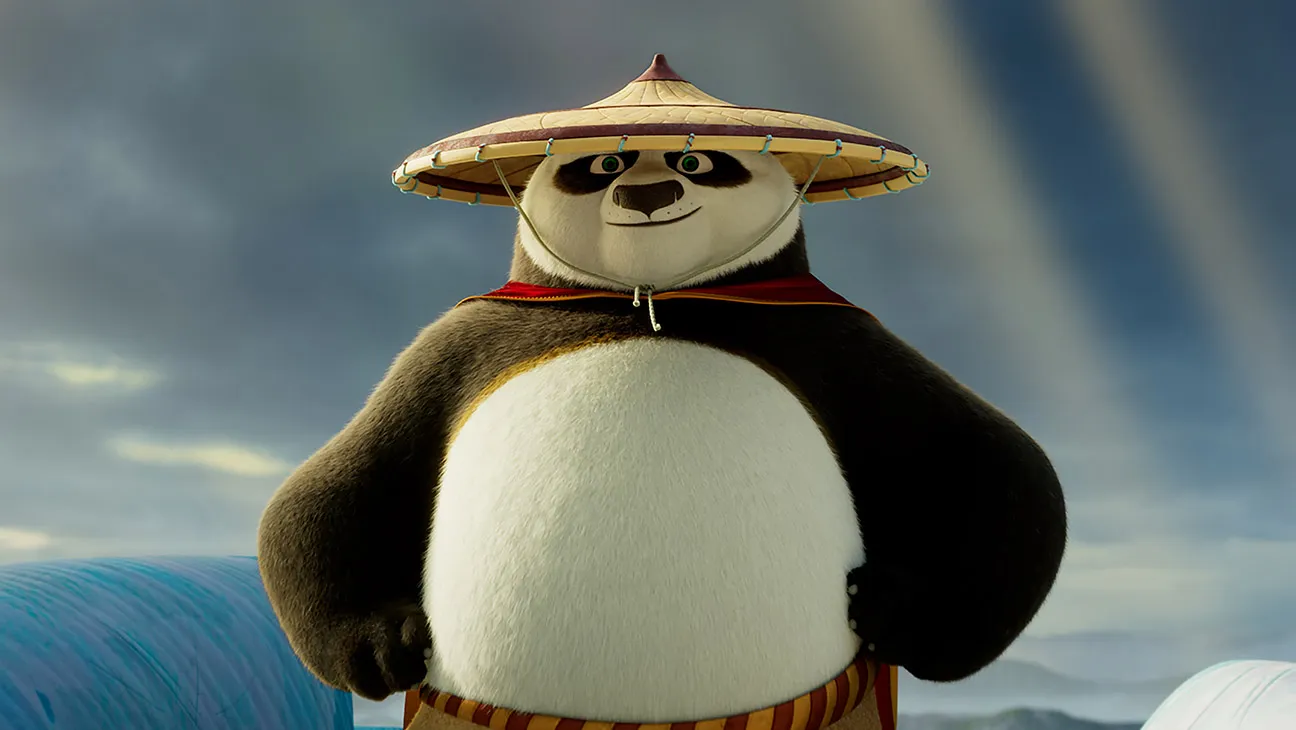
Kung Fu Panda is an animated children’s film made in 2008 following the story of Po, a panda who has big dreams of becoming a martial art master. Following the escape from his prison, Tai Lung, a dangerous criminal, threatens the safety of the town, and Master WuGui has taken up the task to choose the new Dragon Warrior to face against him. This film explores the theme of self-expression and conformity, as well as what happens when we limit ourselves to expectations expected of us versus what happens when we grow into our best selves.
Throughout the story, Po fails to meet standards set by his adoptive father, Master Shifu, and the Furious Five. He doesn’t want to run the noodle shop, he’s far too ambitious for that. But at the same time, he doesn’t measure up to the standards of Master Shifu or the Furious Five, constantly being mocked by them for his lack of skill and his clumsiness. By trying and failing to conform to the expectations and standards of others, Po loses his self-confidence. In a society where success and greatness have only one definition, it limits the number of people that are able to innovate and express their creativity, and it’s only when the people around Po give him room to be himself, to fight as the Dragon Warrior in a manner that, while unconventional, adapts to who he is, can he realise his full potential. In the beginning everybody, including Po, is certain that he cannot be the Dragon Warrior because of his inferior training and skillset. Even we, as the audience rooting for our main character, are again and again discouraged by his continued failed attempts at training for the martial arts. Po is expected to conform, to change who he is as a character to become a cool, calm, and collected kung fu master. But his story teaches us that our individuality and our differences are not burdens or weaknesses, but strengths.
The surface of the Dragon Scroll is blank and reflective, which supports the themes of self-expression and conformity. The Dragon Scroll, throughout the movie, is treated as a source of knowledge that has the ability to make somebody a Dragon Warrior, but when Tai Lung unrolls the Dragon Scroll, only to stare into his reflection, he yells, “It’s nothing!” This moment can show us the difference between these two characters that shows us why Tai Lung could not be the Dragon Warrior, while Po could. Tai Lung needs to be defined by the Dragon Scroll. He needs to be the Dragon Warrior, because he believes that the title, the achievement of being the Dragon Warrior, is what makes him special. His self-hatred and lack of self-confidence, his failure to be something outside his ambition to be the Dragon Warrior, are why, when he is rejected, he lashes out so harshly. Tai Lung truly believes that he is not enough without the Dragon Scroll, which is exactly what makes him unfit to be the Dragon Warrior.
In contrast with Tai Lung, Po becomes the Dragon Warrior because he can be content with who he is and how he fights. He’s not a fighter in the traditional form. He’s lazy, he’s slow, so conventionally speaking, he can’t fight. But when those around him take advantage of his passions and his strengths, they realise that Po doesn’t need to be conventional to be great. There is no advantage to being the Dragon Warrior, and there is nothing in that scroll that makes the Dragon Warrior powerful. The scroll is not a source of strength but evidence of it. When Po looks into his reflection, he smiles, happy with himself. He knows that he doesn’t need some special knowledge or skill to be the best of who he is.
Kung Fu Panda teaches us the valuable lesson of being happy and content with who we are and shows us that we are not defined by titles or expectations but by what we make of ourselves.