By Mariia Bublykova, Year 13
Kupala Night, also known as Kupala’s Night, Noc Kupały, or Ivana Kupala, is a major Slavic folk holiday. The cultural holiday is celebrated on the summer solstice—on the 21st–22nd or 23rd–24th of June by the Gregorian calendar, or on the night between the 6th and 7th of July by the Julian calendar—depending on the country where the celebration is held. Originating back in pagan times, the holiday is now often linked to the Christian feast of the Nativity of St. John the Baptist and the East Slavic feast of Saint John’s Eve. Nonetheless, despite the Christianization of the holiday, its roots and traditions were not forgotten, and some of them are still actively practiced today.
Kupala Night is rich with different rituals linked to fire, herbs, and water, usually performed by young people. Starting at dusk, the celebration usually lasts all throughout the night until the first rays of sunshine at dawn signal the end of the celebration. Among the numerous rituals—often varying depending on the region or country—some of the most popular and widespread ones feature bathing (usually in nearby rivers), jumping over bonfires, making wreaths of wildflowers and herbs, and of course, playing games and singing songs themed around the celebration.
Most of the rituals are themed around the idea of cleansing, either with water or fire. It is believed that during Kupala Night all the evil water spirits leave the lakes and rivers, so it is completely safe to swim and bathe, as well as to be cleansed by the water, which is believed to possess healing or simply magical properties during the celebration.
Cleansing by fire was, and still is, a very popular ritual during Ivana Kupala Night. Usually, a young woman would run up and jump over a bonfire on her own, but sometimes a variation where a young couple jumps over the fire—so as to strengthen their union as well as to get a prediction about whether their union would last—can also be seen. Small details, such as whether they manage to hold hands without releasing them while jumping over the fire, or the way the sparks flow after their jump, are supposed to hint at the future of the couple’s relationship.
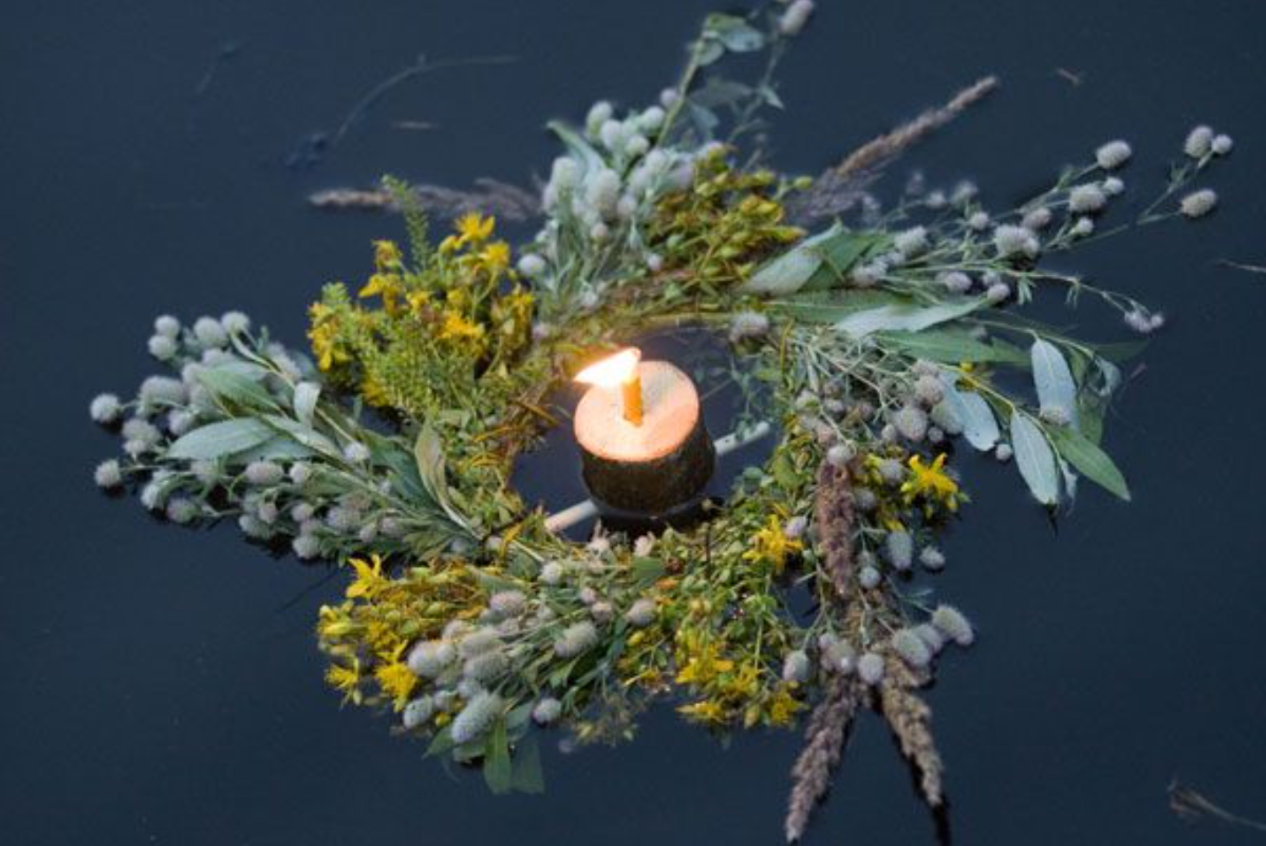
Another notable tradition that has become the main symbol of the celebration over the years is the creation of wreaths. Young women create wreaths or flower crowns with local herbs and wildflowers, often made of periwinkle, basil, geranium, ferns, blackberries, oak and birch branches, and many more—each of the herbs having its own sacred meaning and purpose. Often, the wreath would be adorned with a candle in the center before being set on the surface of water to float for the most important part of the ritual. If the candle was blown out by the wind, or if the wreath sank, it was considered a bad omen. If it floated to the other side of the lake or river, it would mean that her fate was awaiting her there, and if it floated far and steadily out of sight, it was often viewed as a sign that the woman would soon find her true love or get married.
The celebration is usually accompanied by singing and dancing, food and games, as well as smaller local traditions specific to a certain region or even one specific village. Still, no matter the differences, for hundreds of years this holiday has been celebrated all throughout the Slavic countries in Eastern Europe—a beloved, cherished old tradition kept alive to this day.