By Alexander Sparrow, Year 12
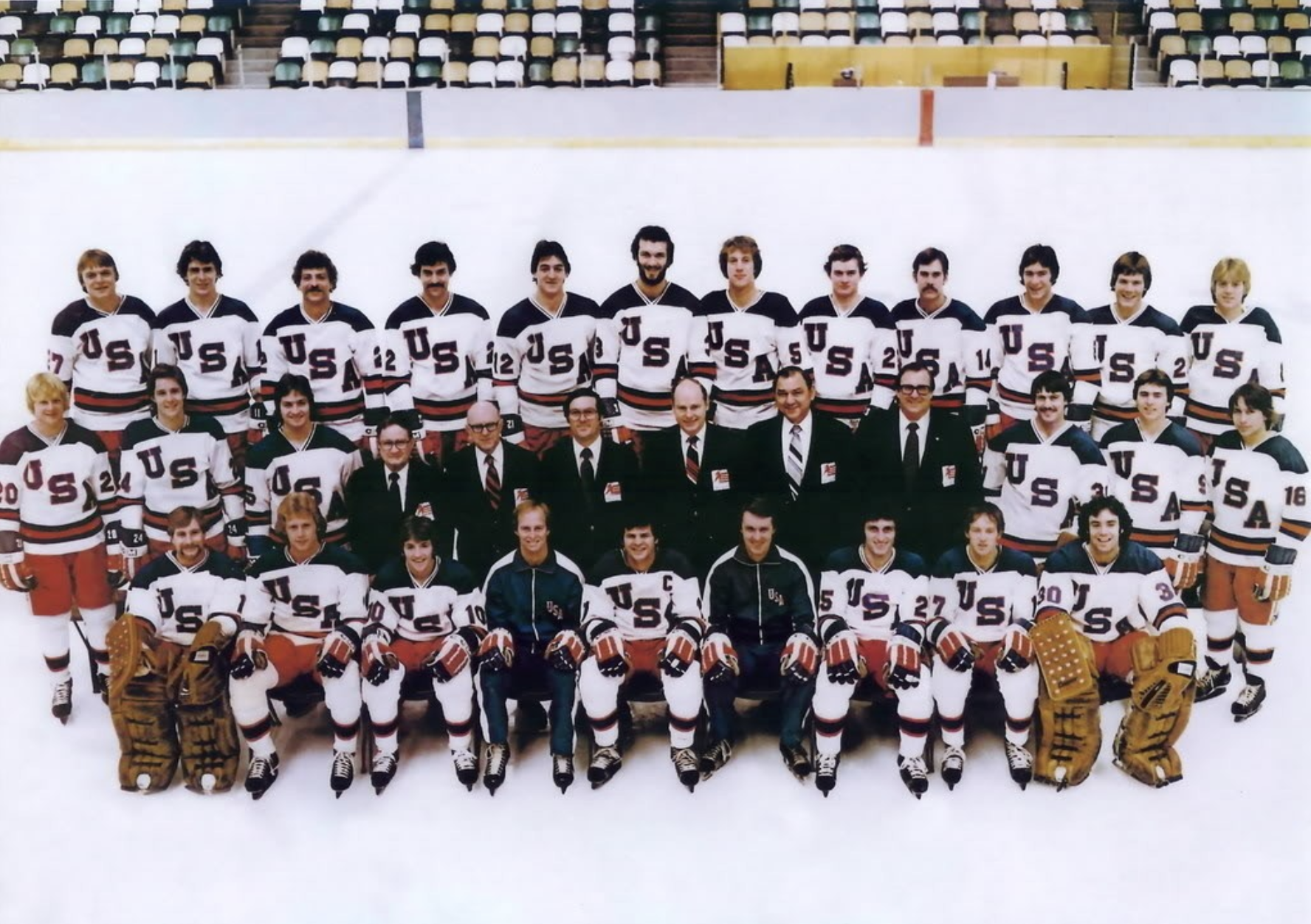
In 1980, at the Winter Olympics men’s ice hockey tournament, the United States men’s hockey team achieved one of the greatest upsets in sports history by defeating the dominant Soviet Union and eventually winning the gold medal—their first since 1960. Known as the “Miracle on Ice,” this victory was not simply the result of luck or chance. Instead, it was the product of Herb Brooks’s deliberate strategy of elite conditioning, psychological pressure, and team unity, which transformed a group of young college players into a disciplined team capable of defeating the world’s most powerful hockey program.
Unlike the Soviet team, which had trained and played together for years, the U.S. roster was composed primarily of college athletes drawn from rival programs. In 1979, sixty-eight of the top college players in the US were invited to Colorado Springs for the final team tryout. The tryouts were intended to last a week, and the players were initially supposed to be chosen by Head Coach Brooks, Assistant Coach Patrick, and the advisory staff. However, in less than a day, the final roster was already chosen by Coach Brooks alone. The advisory staff were furious, and felt Herb was missing the best players, even assigning his national championship goalie, Steve Janaszak, to back up Jim Craig, whose game was off since the death of his mother. However, Brooks coached the majority of the boys, studied film of their playing, spoke with their coaches, and scouts in the area, and stated that he already knew his team. Brooks also said, “I’m not looking for the best players; I’m looking for the right ones.”
Brooks had to manage a toxic rivalry between players from the University of Minnesota and Boston University. The most intense “private cold war” existed between Jack O’Callahan and Rob McClanahan, who had physically fought during their college careers, as O’Callahan believed that McClanahan had robbed him of the 1976 national championship. Brooks exploited this tension, positioning himself as the common enemy to force the boys to stop hating each other and start hating him. By making the team miserable together, he transformed a fractured group of rivals into a cohesive brotherhood.
Brooks’s training regimen was built on the fundamental belief that “the legs feed the wolf,” prioritizing unprecedented aerobic and anaerobic endurance to match the Soviet pace. The centerpiece of this conditioning was the “Herbie” – a grueling series of whistle-blown line sprints where players skated the full length of the rink, touching the goal line, blue lines, and red line in rapid succession. In addition, Brooks utilized high-intensity interval training and even psychological testing, such as the 500-question MMPI (Minnesota Multiphasic Personality Inventory), to ensure his players possessed the mental “internal locus of control” required to survive his “unorthodox” methods.
This unity was tested after a lackluster 3-3 exhibition (friendly) draw against the Norwegian national team in September 1979. Furious with their lack of effort, Brooks ordered the team to stay on the ice for “Herbies”. He kept them skating long after the arena lights were shut off, ignoring the trainer’s protests. Herb had to get the fact through those boys’ minds that they couldn’t win on talent alone, because they didn’t have enough talent. Herb made them do sixty to ninety minutes of straight “Herbies” that day, to prove a point – when they put on that jersey, they represent themselves and their teammates, and the name on the front (USA) was a lot more important than the name on their back.
Just days before the Olympics, the team faced the USSR at Madison Square Garden and was humiliated in a 10-3 loss. While the world saw a blowout, Brooks used the defeat as a learning opportunity and to refine his strategy.
When the Olympics finally began in February 1980, the U.S. was already struggling with their first game against Sweden. By the end of the second period, it was 2-1 for Sweden, and Rob McClanahan suffered an Upper-Leg Contusion-believing he was done for the night. However, Brooks believed that he could still play even if it hurt. Brooks got into the locker room, and immediately started calling out Rob for being a “cake eater” and “I want you to be a hockey player”–to get into his head and make him mad. This resulted in the team stepping up and getting furious with Herb, and took out their frustration on Sweden-scoring one more goal with seconds to go and drawing the game against the third ranked in the world just under Czechoslovakia.
After Sweden, the USA were on a roll. Winning against Czechoslovakia (7–3), Norway ( 5–1), and Romania (7–2). They were at a critical turning point. Eventually, when the US and USSR met again, it was considered to be a deciding game for the US. The game started as expected, with the Americans behind the Soviets by a goal. But with time and pressure, the Americans began to outskate the Soviets. The US even managed to bench what was widely considered the best goaltender in the world, Vladislav Tretiak, after a 2-2 equalizer with one second left in the second period. The head coach of the Soviet Union turned to Vladimir Myshkin, which was unusual because Tretiak was the coach’s bread-and-butter for over a decade. In the third period, three goals were scored, but the US took the lead for the first time ever. With Mike Eruzione scoring the game-winning goal at the 10:00 mark—the stadium was in bedlam. Brooks’s conditioning allowed the team to outrun the aging Soviet stars. When the final buzzer was blown, the score was 4-3 for the young US team, marking the game as a “Miracle on Ice.” Later on, the US won their final game against Finland (4-2), coming from behind once again and securing the gold medal.
The victory over the Soviet Union carried significance beyond sports, as it took place during the Cold War, turning the game into a symbolic clash between two rival superpowers and amplifying its impact on national identity and global perception. Brooks turned the “unorthodox” into the legendary, proving that a team built on the right chemistry and relentless conditioning could overcome the greatest dynasty in sports history.