By Eloise fenton, Year 11
There will be spoilers in this analysis.
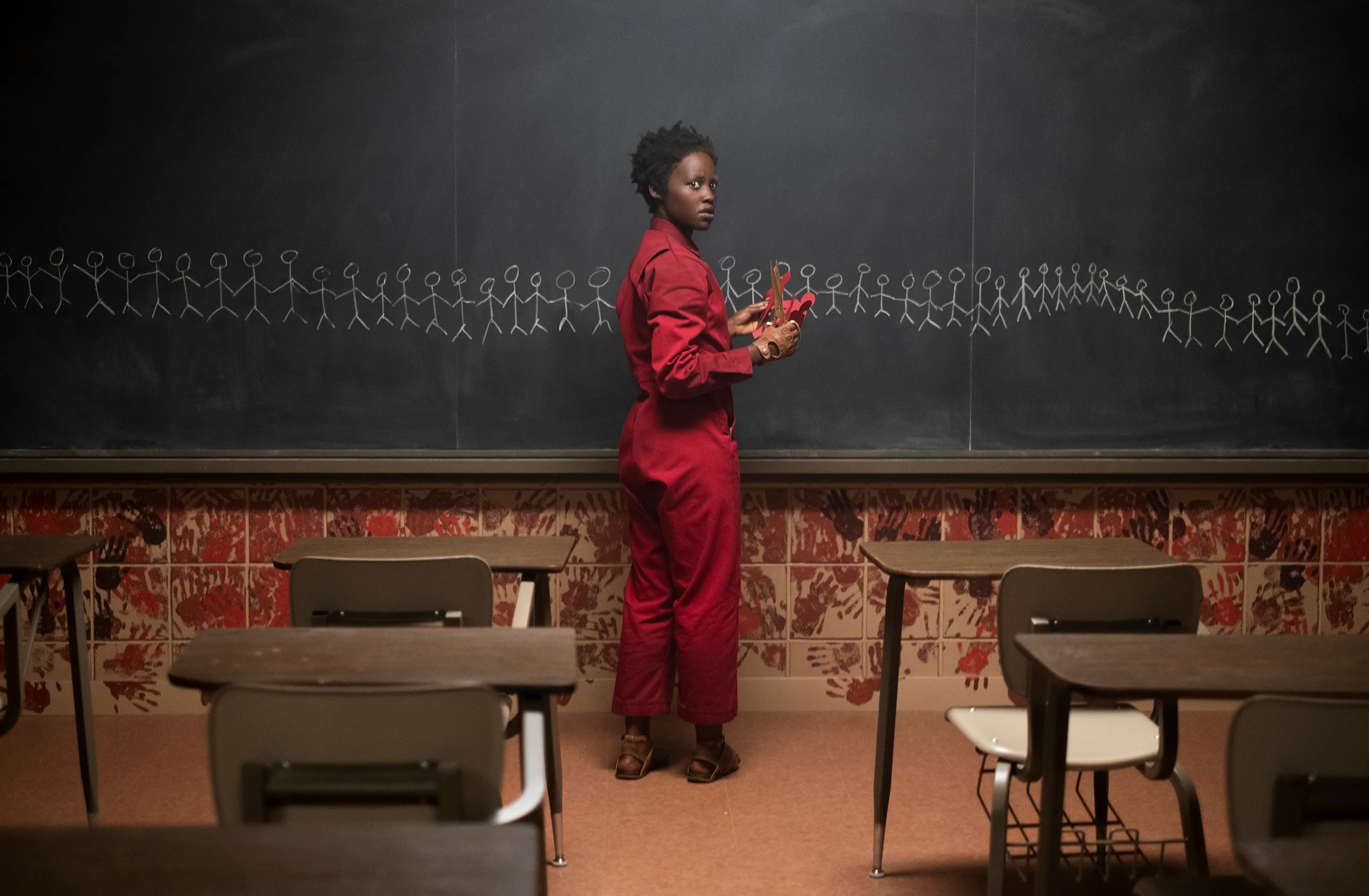
Jordan Peele is one of the most talented people in the industry right now. We’ve seen him cover peak comedy to writing and directing dark, tragic horror films with a critique of society. US is no different. The 2019 film US, written and directed by Jordan Peele, follows Adelaide, accompanied by her kids and husband, returning to the beachfront she grew up in, though it is haunted by traumatic experiences from the past. Her worst nightmare comes true when four masked strangers come to attack the house, forcing the family to fight for their lives. Though when the mask comes off, it is revealed that the attackers’ appearance is one of them. Though this movie is so much more than a dumb slasher, it calls out the American dream. The dream that anyone can achieve success if they work hard enough. The film uses the tethered (menacing, silent doppelgangers of the American population who live in vast underground tunnels) as a central metaphor to describe the oppressed underclass. US critiques the American Dream by showing that prosperity and comfort for some Americans are built on the suffering, exclusion, and invisibility of others, symbolised through the Tethered.
The illusion of the American dream is the first deconstructed idea. The Wilson family is shown to embody this dream, though it’s fragile and superficial. The family is shown to own a beach house, demonstrating financial stability and leisure, key ideas in the American dream. The fact the family can even afford to take time off shows that they have time and money to live, not just survive. Though even with all of this, Gabe (the father) is obsessed with the idea of buying a boat. The purchase of the boat is to fulfil the desire to compete with his weather friends. Once the boat is bought, it is shown as inconvenient and nowhere near as expensive as his friends’. It highlights how the American dream is rooted in status anxiety, competition and consumerism. Jordan shows that success is measured by outward display of wealth, not actual genuine security. Overall the Wilson family appears to embody the The American dream, with its superficial success, excites in dramatic contrast to the Tethered, their suffering exposes the inequality and social exclusion that sustain this ideal.
Discussing the Tethered, their importance is to see them as the “forgotten Americans”. The Americans who are excluded from this dream. The first example is how the Tethered live underground, forced to mimic the lives of those above without any authority. The lack of freedom revealed that this dream is not universally attainable, it depends on a system where the success of some is built on the sufferings of others. Another example of this is through Red’s (the Tehthered version of Adelaide) speech, where she describes her life of suffering. When asked what they are, she states, “We are Americans.” This implies that the American system of oppression is not an accidental its a systemic part of the society that upholds the American dream. Furthermore, the Tethered symbolises the communities of those in poverty and people exploited and ignored by the American structure. By presenting them as literal shadows of the privileged, it exposes the hidden underclass that is beneath the surface of American society. Overall the film shows that the American dream helps those in privileged places and relies on oppression to thrive. That the comfort of some is only possible by the denied opportunity of others.
Jordan also touches on the idea that violence underpins the American Dream. This is most apparent in the Tethered uprising, where the oppressed underground population rises violently against the current population above them. The rebellion is not random but years of repressed suffering, implying that the systemic inequality creates conditions in which violence becomes the only means of reclaiming agency. This is yet reinforced by the reference to the campaign “Hands Across America” in 1986. This charity event had millions of Americans join hands in a human chain to raise money for poverty relief. The campaign aimed to show an image of national unity and collective progress, it was highly criticised for its logistical failure and limited impact. This showed the exposing gap between symbolic gestures and real social change. In the film, the failed idol is reshowed as the Tethered form their human chain across the country, illustrating the once hopeful image as an image of unity into one eerie uniformity and control. This reference reveals the superficiality of American solidarity. Jordan tells the audience that the American Dream relies on the empty performance of unity, hiding the serious inequalities that continue to divide our society to this day. Ultimately the film suggests that the American Dream is founded and built on explosions, and the violence of the Tethered is a direct consequence of a system that denies them freedom.
Last but definitely not least is the Adelaide identity twist. The revelation that Adelaide is actually one of the Tethered. The twist complicated the idea of who deserves the American Dream. Despite originating from an oppressed underclass underground, Adelaide successfully achieved being a part of the surface society. She did gain the American dream, gaining stability, a family, and freedom to a certain extent. Though this success was not a result of hard work but rather an act of violence, as she takes her counterpart. This challenges the audience to think about the notion of meritocracy that underpinned the American dream, exposing it as a fraudulent illusion rather than a fair system of opportunity that it claims to be. It raises the question about how unsettling moral questions about who has the right to success are and if privilege is ever truly deserved. By presenting the protagonist as someone who possibly earned her life through displacement rather than effort, Jordan suggests that the The American Dream is not based on fairness or equality, though, but instead on an arbitrary advantage and the exclusion of others.
To conclude, US exposes the darker realities of the American Dream, showing it not as a universal promise of success but as an illusion sustained by oppression. With the superficial lifestyle of the family, the film illustrates the performative nature of success, while on the other hand, the Tethered represent a hidden underclass that is excluded from opportunities by the system.