By Penelope Stopford, Year 11
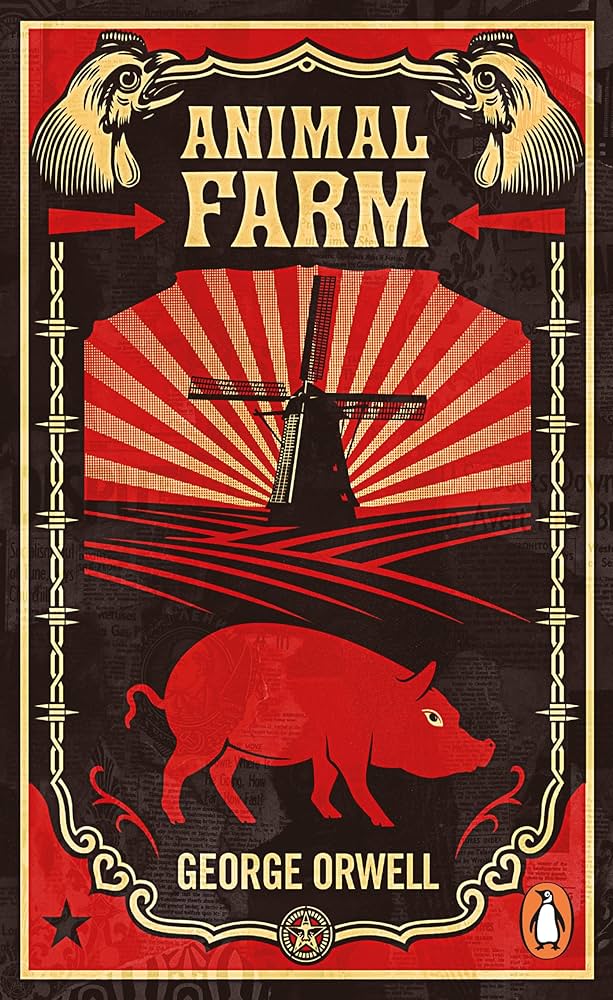
For the past few months, Year 11 theatre students have been working on Animal Farm, a play based on George Orwell’s 1945 novel, which they have been performing throughout last week. Set in England in the mid-20th century, Orwell wrote the book as an allegory of the Russian Revolution, where the events mirror those of the Russian Revolution.
For those who have never read it, Animal Farm is a story that explores key ideas of power and corruption. The book tells the story of the farm animals, led by the pigs, who overthrow their human farmer, establishing their own society where all animals are equal. The pigs, especially Napoleon, gradually take control and begin to abuse of their power, and by the end, make the farm just as unequal as before.
To better understand the play, it is important to understand the lead-up to the Russian Revolution of 1917 (or the revolution on Manor turned Animal Farm). Before the revolution, Russia was ruled by Tsar Nicholas II (represented by Mr Jones, the human farmer). While most of the population lived in poverty, a small portion of the population, the elites, controlled most of the money and held most of the power. The revolution aimed to overthrow the Tsar and give power back to the working class, establishing a democratic and more “equal” regime. Throughout the book, Orwell criticises the Russian leaders who were supposed to create a fairer and better future for the Russian working class.
The play demonstrates the idea that power always leads to corruption and suffering, illustrating how social classes are often unified against a common enemy (the animals against the humans), only to become divided once that enemy is eliminated. The absence of Mr Jones and his tyranny over the farm leaves space for the next oppressor, Napoleon, to assume total control. Two of the Russian Revolution’s key players, Trotsky and Stalin, represented by Snowball and Napoleon respectively, show how power struggles can lead to corruption and betrayal, and how those in power manipulate others for their own benefit.
Today, Animal Farm remains incredibly relevant, showing the development of modern-day society and how people interact and are able to deceive and change their ways to get what they want. While it symbolises the rise of the Soviet Union under Communist rule, it can also be linked to any form of human society, whether it be capitalist, communist, fascist, or socialist. The characters all represent different parts of a nation, the pigs representing the government, the dogs portraying the army, and the other animals depicting the working class.
It is therefore an incredibly valuable piece to be taught or performed in school as it shows students how easily power can be corrupted if it isn’t questioned. Orwell demonstrates how leaders can slowly take control through manipulation, changing rules, and spreading propaganda, teaching students to think critically, question authority, and not blindly accept what they are told. It also highlights the value of equality and fairness, showing how easily these can be lost if people speak up and stand for what they believe in.