By Skyler Mason, Year 12
Known for his unique gothic fantasy style, Tim Burton is an American film director who’s responsible for several acclaimed films such as Corpse Bride, Alice in Wonderland, and my personal favourite, Edward Scissorhands.
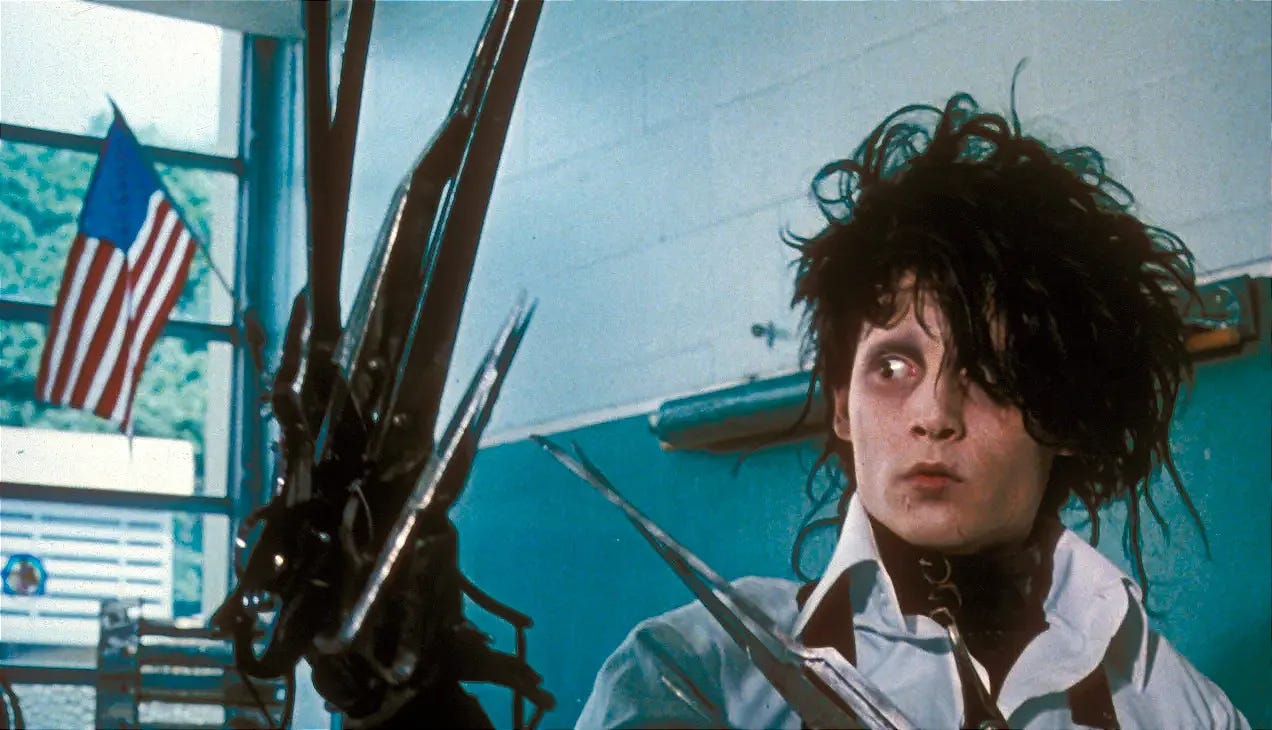
Edward Scissorhands is a standout for many reasons, but even with its captivating plot and impeccable casting (starring renowned actors like Johnny Depp and Winona Ryder), what I find to be the most striking feature of the film is its unique cinematography.
While Burton’s style is an attribute many of his films share, Edward Scissorhands is the perfect illustration of how he uses this aesthetic to not only emphasise the themes but to really make the story come to life.
Atmosphere is a key element of Burton’s direction style, with fantastical visuals and fairytale-reminiscent music enchanting the viewers’ ears as well as eyes. The elements of fantasy, such as Edward having scissors in the place of hands, remain grounded by the aesthetics of the classic American neighbourhood to retain a sense of normalcy. Aside from creating alluring visuals, the stylistic choices accentuate the message this film communicates, which is to be kind in the face of peculiarity.
The most evident example of this would be in the characterisation of Edward himself.
His eccentrically gothic design visually distinguishes and isolates him as the ‘other’. This is consistent throughout the film. His original home is a remote castle spatially and visually separated from the exclusively pastel, homogeneous 1950s neighbourhood. This contrast, where the houses and family dynamics are identical and even actions happen in unison, is where the fantastical aspect of aesthetics comes into play. Furthermore, Edward’s contrasting appearance—an extremely pale complexion with pitch-black hair and clothing—prevents him from aesthetically integrating with the townspeople. As Burton’s style naturally takes each visual to the extreme, it solidifies this contrast, which in turn elevates the message.
This visual uniformity not only highlights Edward’s otherness but also builds a sense of fragility for his place within the community. His sharp contrast with the surrounding society foreshadows his rejection from it, as his acceptance into society is based on novelty more than genuineness. This is evident when Edward is exploited by a group of teenagers, leading to the immediate loss of the position he had gained.
Despite the extremity of these aesthetic contrasts, the challenges people who are different face in society remain a relevant social issue. Being visually distinct from the majority can often severely harm a person’s ability or likelihood of integration, which is especially reflected by the conclusion of the film, where Edward ultimately returns to his isolation.
Ironically, Tim Burton’s aesthetic decisions regarding casting in his films have mired him in controversy, with the lack of representation earning him accusations of racism. Having spread across most social media platforms, the subject has become increasingly contentious, with articles titled “The Nightmare Before Diversity” and “Tim Burton: Imaginative Until it Comes to Race”.
While some defend it as a requirement of the aesthetic, others dismiss the subject as a matter of little importance. Personally, I think the lack of representation speaks volumes on his creativity (or lack thereof); if people of colour don’t fit in the “aesthetic”, the issue is with his artistry.