By Victoria Hristova, Year 13
The hour has come when it will become clear why our two most complex and well-supported theories on the nature of the Universe do not, in fact, describe reality fully. It has already been established that Einstein’s theories of relativity unlocked areas of the cosmos that had previously been inaccessible with Newtonian physics: black holes, the Big Bang, expansion, and the shape of the Universe, to name a few. Note the scale of these events; cosmic, gargantuan. Yet try to apply relativity to the simple interaction of two particles, and everything falls apart. This discrepancy is what has been puzzling physicists for nearly 70 years. To understand where it stems from, we must first understand how, if not through relativity, to describe reality: this is where we enter the quantum world.
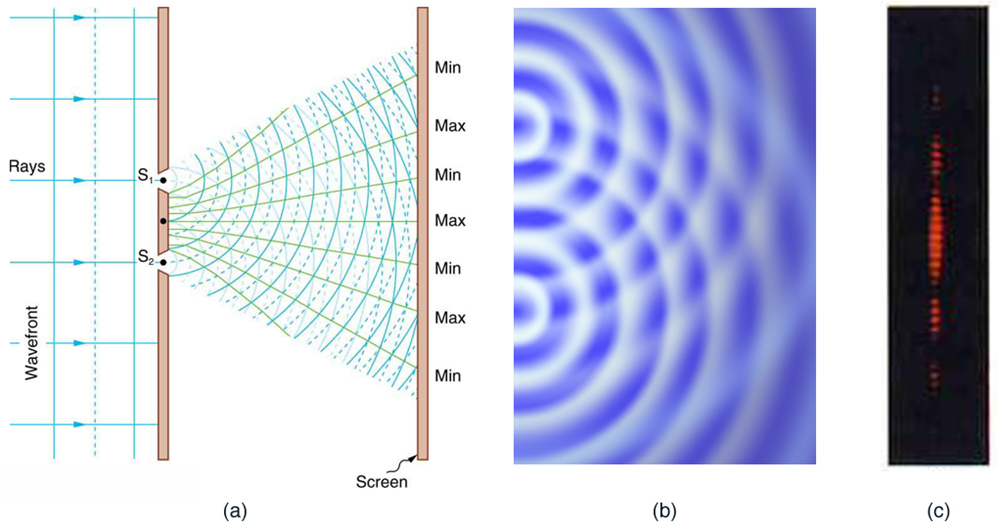
It all begins with light. We have been diligently taught that light is made up of fundamental bundles of energy, quanta, that are commonly known as photons. Photons are particles, albeit slightly odd ones. However, as Thomas Young demonstrated in the early 1800s with an experiment now referred to as the “double slit experiment”, light behaves like a wave. Yes, like any wave of water, light, as it passes through two parallel slits onto a photographic plate, forms an interference pattern, even if one photon at a time is fired. Intuitively, we would be inclined to believe that the light would form two parallel strips, like the slits, on the photographic plate; each individual photon would have to pass through either the left or the right slits. If one slit is closed and the photons are fired through the other, they will amalgamate as expected, in a line, on the plate. But when both slits are opened, we see this interference pattern. How can a particle passing through one slit be affected by whether or not the other one is open? This is where conventional reasoning begins to fail; we must accept that light has both wave and particle properties, that it is both a wave and a particle simultaneously. This is the principle of wave-particle duality, crucial to understanding the quantum properties of systems. The same duality was demonstrated for electrons, classically thought of as a particle, with the same experiment. Therefore, it was concluded that all matter possesses this duality (rest assured, the wave characteristics of it can only be observed and felt at infinitesimally small scales). But… waves of what? The wave properties of particles are not defined as a physical parameter, but rather as the probability of where the particle is most likely to be found: the larger the magnitude of the probability wave, the more likely it is that the particle itself will be there. In the context of our double slit experiment, this means that the number of times the particle (photon or electron, it does not matter) is found at a given place is determined by the shape of its probability wave, which is of a greater magnitude at the luminous peaks and smaller at the troughs. Although this is already sufficient to begin seeing discrepancies with the deterministic nature of relativity, physicist Richard Feynman took a step further in explaining the probabilities of quantum mechanics: he stipulated that the probability of the particle in the double slit experiment to be measured at a certain location is the combined effect of all possible ways for it to get there. In simpler terms, the particle passes through every existing path for it to reach its final destination. Of course, it is not possible for it to reach the ends of the Observable Universe and back in the time we fired it and measured its arrival on the plate, but Feynman’s “sum-over-paths” method is foolproof—it makes sure that all paths but one “cancel” each other out when their contributions to the probability wave are combined. Already, we find ourselves in the deep ends of quantum theory. If nothing else, take this away from this first section: a particle can behave as both a particle and a wave simultaneously, and the magnitude of the wave determines where the particle is most likely to be found; quantum mechanics is inherently probabilistic in nature.
After light, came uncertainty. Let us return to the double slit experiment, with an electron. You wish to determine which slit the electron is passing through. To do that, you must observe the experiment. This may sound trivial, but consider the implications. To see something, we do something, like illuminate it with a light source. Light is made up of photons carrying energy proportional to their frequency and inversely proportional to their wavelength. These photons, even if they are fired one by one, still transfer their energy to the photon when they bounce from it, disrupting its state of motion. Experimental observations show that this causes the experiment to go from an interference pattern to our intuitive description with the two strips aligned with the slits. Determining the electron’s position disturbs its motion, its velocity. Even with a single photon, we can only pinpoint the location of the electron to the precision of one wavelength. This means that if we were to use a higher frequency (shorter wavelength to decrease uncertainty, we would be disrupting the photon more because higher frequency photons transfer more energy. The opposite is true as well: if we were to use a lower frequency, it would be at the cost of precise positioning within the error of one wavelength. This is Heisenberg’s uncertainty principle: we can never know with full precision both position and velocity simultaneously. The same is applicable to the precision of energy measurements and the time they are carried out for: the more precisely one wants to measure the energy within a system, the longer one has to conduct the measurement. This entails a curious phenomenon: for a short enough time, particles can “borrow” wildly fluctuating quantities of energy, so long as this energy is returned to the Universe within a reasonable time (determined by the uncertainty principle), as energy can never be created or destroyed. From the uncertainty principle, we can therefore conclude that the more precision we try to obtain in our measurements, whether it is by increasing frequency to measure position or by decreasing the time of measurement for energy, the system we are measuring gets progressively more agitated. Our measurements get less precise! On a large enough scale, these fluctuations, quantum foam, seem to “cancel” each other out, making an empty region of space seem still and calm, although on a microscopic scale, it is anything but.
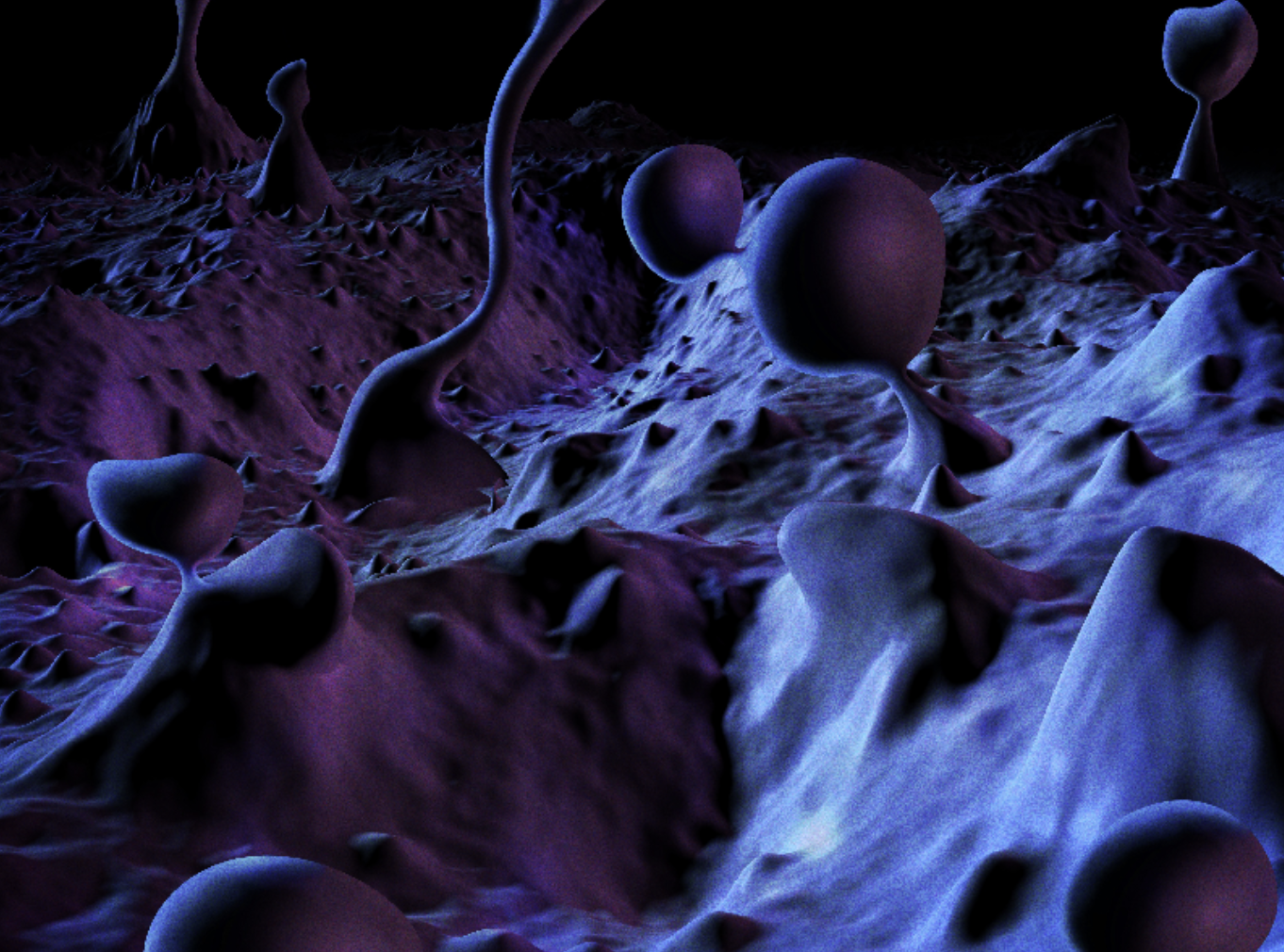
The final piece of the quantum puzzle is quantum field theory. Explaining it fully would require another series of articles; therefore, bear in mind that this is a grossly oversimplified description of it. Our Universe is governed by four fundamental forces that dictate and can describe every single interaction between particles and sub-particles. The electromagnetic force explains how atoms are held together; the weak force describes the radioactive decay of elements; and the strong force, which explains the stability of the nucleus within atoms. The fourth one, which has proven quite elusive, is gravity, the only one for which we do not yet have a quantum field theory to describe its nature, although it displays similar characteristics of symmetry as the other ones. Allow me to correct myself, for I have been misleading. Incompatibility between relativity and quantum field theory does not arise from the nature itself of the theories as probabilistic or deterministic. At least not entirely. For one, special relativity was fundamental to establishing the field theories for the weak, strong, and electromagnetic forces. Rather, the issue comes from one thing only: gravity. Gravity in general relativity is described as the curvature of spacetime from the presence of mass; space devoid of mass is therefore flat. It has a smooth spatial geometry. However, recall what happens as we inspect this empty space at progressively smaller scales: quantum fluctuations get more violent as the scale decreases due to the uncertainty principle. The more violent the fluctuations, the greater the distortion of the surrounding spacetime. As physicist Brian Greene quite neatly puts it, “the uncertainty principle is in direct conflict with the central feature of general relativity—the smooth geometrical model of spacetime”. Think of it as a dot matrix picture. From far away enough, it looks like an even, continuous drawing. Upon closer inspection, its turbulent arrangement of dots becomes apparent, albeit this turbulence only appears at scales of 10-33m in the Universe.
You may now be wondering, why does this even matter if it occurs on such a negligible scale, and both general relativity and quantum theories can be applied perfectly fine at their respective scales? Frankly, some physicists are content to leave it as such. Others, however, are profoundly troubled by the implications: our two most sophisticated theories are still inconsistent at a deeper level, meaning we do not yet have a full, logical description of the Universe at its most basic. Notwithstanding the hundreds, if not thousands of attempts to modify either theory to fit the other, there is still a fundamental flaw with our reasoning. For now, it seems, the nooks and crannies of the Universe elude us, hidden from sight and understanding. All because of something as seemingly mundane as gravity.
Sources Cited
“Quantum Physics.” New Scientist, 2019. http://www.newscientist.com/definition/quantum-physics/.
CERN. “The Standard Model,” November 13, 2025. http://www.home.cern/science/physics/standard-model.
Hossenfelder, Sabine. “What Physicists Have Been Missing.” Nautilus, February 2, 2024. https://nautil.us/what-physicists-have-been-missing-506607/.
Weinstein, Steven, and Dean Rickles. “Quantum Gravity.” Stanford.edu, December 26, 2005. https://plato.stanford.edu/archives/sum2023/entries/quantum-gravity/.