By Wu Zhang, Year 12
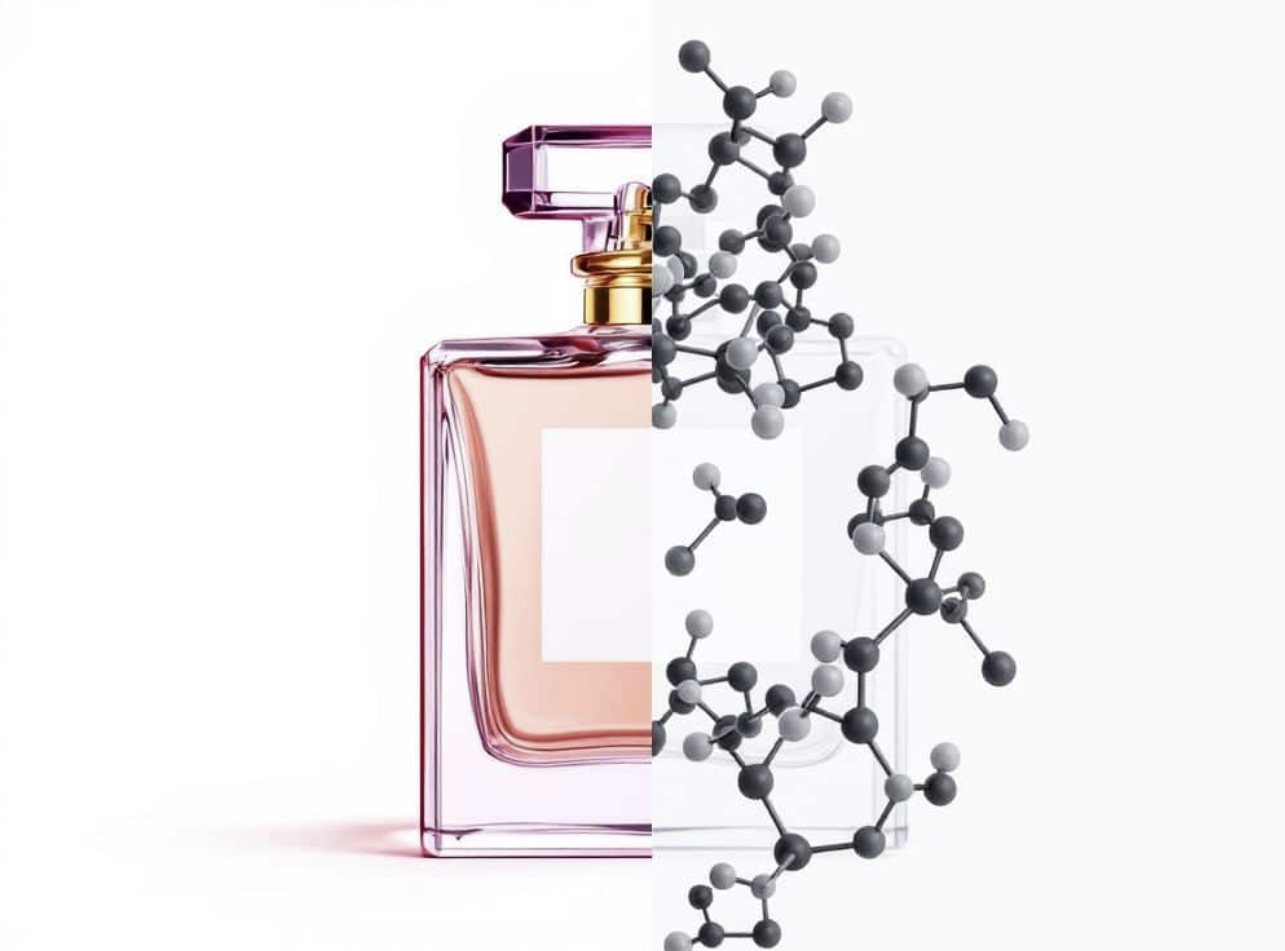
The field of fragrances may feel like pure artistry, but the scents we love so much are built from organic molecules carefully chosen for their shape, volatility, and interactions with our noses. Iconic perfumes like Dior Sauvage, Chanel No. 5, or Paco Rabanne Phantom Parfum all rely on chemistry to create their signature scents. Understanding the organic chemistry behind these fragrances will reveal how familiar scents are truly molecular masterpieces.
Firstly, focusing on the major organic families most scent molecules belong to, each associated with certain characteristic smells:
- Esters (R-COOR’): Esters are responsible for many fruity and sweet fragrances, formed when an alcohol and a carboxylic acid react. For example, ethyl (alcohol part) butanoate (carboxylic acid part) gives off a pineapple-like aroma, whilst isoamyl acetate smells distinctly like bananas.
- Aldehydes (R-CHO): Long-chain aldehydes like decanal contribute “clean”, slightly citrus scents, famously used in Chanel No. 5. Their reactive carbonyl group is what gives them the perceived sharpness and brightness.
- Terpenes (a wide category of aromatic compounds that are responsible for the scents of many plants): Terpenes are built from repeated isoprene (2-methyl-1,3-diene) units and are highly volatile, which helps them evaporate easily into the air. For example, limonene smells like oranges; linalool like lavender; geraniol like roses.
- Ketones (RC(=O)R’): Ketones are another important class of fragrance molecules that often contribute musky, floral, or sweet base notes in perfumes. The carbonyl functional group (C=O) influences both their scent and volatility. A classic example is muscone, a macrocyclic ketone responsible for the characteristic “musk” aroma found in many modern perfumes.
Additionally, for a molecule to be detected by olfactory receptors, it must be volatile, easily evaporated at S.T.P. (Standard Temperature and Pressure) and small enough to fit into receptors inside the nose. These receptors are proteins with specific shapes and chemical environments.
When a scent molecule binds to a matching receptor, it triggers a signal that the brain interprets as the corresponding smell. Even small changes to a molecule, like one functional group added or one bond rotated, can shift this interaction and create a completely different scent.
This leads to one of the most fascinating and confusing aspects of fragrance chemistry, stereochemistry, the study of how molecules are arranged in 3D space.
Some molecules exist as enantiomers (a specific type of isomer), mirror images that cannot be superimposed (cannot be aligned in all dimensions, despite looking similar). Even though they contain the same atoms in the same order, they can smell entirely different because they bind to receptors differently. For example, R-carvone (righthanded) smells like spearmint, whilst S-carvone (lefthanded) smells like caraway seeds; similarly, the enantiomers of limonene (mentioned before) smell like either orange or pine, and the two forms of menthol (an alcohol) differ in their cooling effect. In perfumery, selecting the correct enantiomer is crucial, as even a subtle change in molecular orientation can dramatically alter a fragrance’s overall profile.
Additionally, perfumes can be made from either natural extracts or synthetic molecules, and each approach offers unique advantages. Natural perfumes are derived from essential oils extracted from flowers, fruits, spices, and resins. These oils are highly complex, often containing hundreds of different compounds, which gives them rich and nuanced scents. However, the composition of natural extracts can vary depending on season, geography, and even weather, making consistency a challenge for perfumers. Synthetic fragrances, on the other hand, are created from purified molecules produced under controlled chemical conditions. This allows perfumers to replicate natural scents with consistent quality, design aromas that do not exist in nature, and create formulas that are more stable and environmentally sustainable. A prominent example is Iso E Super, a velvety, woody-amber synthetic molecule that features in many modern perfumes. Compounds like this demonstrate how chemistry enables creativity beyond what nature can provide.
In conclusion, perfumes and fragrances are a fascinating intersection of chemistry and creativity. Every aroma we perceive, from the zesty freshness of limonene to the warm sweetness of vanillin, arises from molecules interacting with our receptors in our noses. Understanding the organic chemistry behind fragrances reveals that perfumes are not just pleasant smells, but more like carefully engineered compositions, crafted molecule by molecule, to create a specific olfactory experience that we have grown accustomed to.
Works Cited
Bashara, Amy. “Esters – the Fruity Building Blocks of Flavor – Imbibe.” Imbibe, 19 Oct. 2016, imbibeinc.com/technical-industry-guidance/esters-fruity-building-blocks-flavor.
“Carvone: One Molecule, Two Different Scents and Flavors.” American Council on Science and Health, 1 Aug. 2018, www.acsh.org/news/2018/08/01/carvone-one-molecule-two-different-scents-and-flavors-13255.
“Carvone: One Molecule, Two Different Scents and Flavors.” American Council on Science and Health, 1 Aug. 2018, www.acsh.org/news/2018/08/01/carvone-one-molecule-two-different-scents-and-flavors-13255.
“Comparatively Speaking: Natural vs. Synthetic Fragrance.” Cosmetics & Toiletries, 28 Dec. 2011, www.cosmeticsandtoiletries.com/cosmetic-ingredients/sensory/article/21834851/comparatively-speaking-natural-vs-synthetic-fragrance.
FindaScent. “Vanillin in Perfumes and Fragrances.” Findascent.com, FindaScent, 2024, www.findascent.com/ingredients/v/1684/vanillin.php. Accessed 4 Dec. 2025.
Iberchem. “Aldehydes: The Success behind Chanel No 5 – Iberchem.” Iberchem, 6 Nov. 2017, iberchem.com/ingredient-profile-aldehydes-the-success-behind-chanel-no-5/.
—. “Aldehydes: The Success behind Chanel No 5 – Iberchem.” Iberchem, 6 Nov. 2017, iberchem.com/ingredient-profile-aldehydes-the-success-behind-chanel-no-5/.
“Muscone | 541-91-3.” ChemicalBook, 2025, www.chemicalbook.com/ChemicalProductProperty_EN_CB1378768.htm. Accessed 4 Dec. 2025.
“Stereoisomerism and Smell.” Chemistry LibreTexts, 13 Aug. 2016, chem.libretexts.org/Ancillary_Materials/Exemplars_and_Case_Studies/Exemplars/Foods/Stereoisomerism_and_Smell.