By Abigail Shields, Year 12
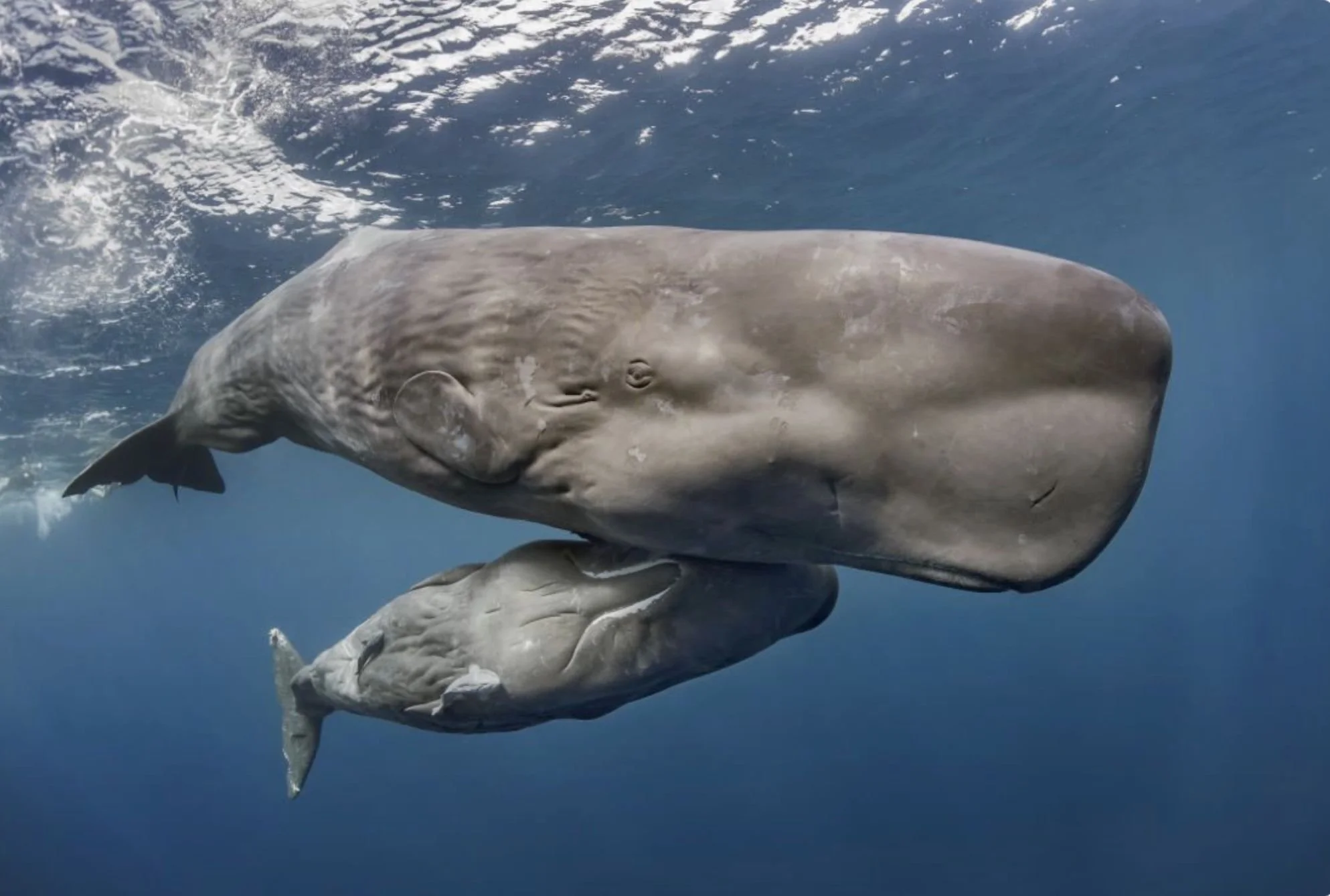
The sperm whale (physeter macrocephalus) is one of the most fascinating creatures in the biological kingdom and a puzzle to be solved. Unlike other cetaceans, which largely dwell within shallow waters, sperm whales regularly undertake long, deep excursions into the mesopelagic (twilight zone) and bathypelagic (midnight zone) layers of our planet’s oceans. The conditions found there are, of course, hostile to mammalian life. Their successful adaptation is, therefore, a complex of advanced specialisations across a broad spectrum.
Their underwater activities occur at depths of 1,000m to 3,000m, where the penetration of light is no longer possible. The pressure below these levels is such that it rises by one atmosphere every 10m, capable of flattening any construction or building that is not shielded. The environmental temperatures are close to freezing levels, thus extremely hazardous when considering thermoregulation and heart functioning in mammals. While performing these dives, sperm whales display a marked decrease in heart rate from 60 bpm in the surface-dwelling stage to 10 bpm when diving. This helps them conserve oxygen and increase blood supply to essential organs such as the brain and heart. The blood supply to peripheral organs is decreased temporarily. The lungs of sperm whales are compressed upon entry into water to avoid intake of nitrogen and decompression sickness. The rib cage of sperm whales is elastic and is able to compress due to high pressure to avoid bone damage.
In addition, they also have an unusually high level of haemoglobin and myoglobin, which helps store large amounts of oxygen in the blood and muscle tissues. A high level of myoglobin gives muscles an ink-like quality, while its oxygen-carrying capacity is responsible for their muscles being able to function aerobically during long dives, allowing them to hold their breath for up to two hours.
In particular, their brains are fascinating, and it has the largest mass of any existing animal that has been discovered; it’s approximately six times that of ours. A large part of the brain is committed to the sense of hearing as opposed to sight in aphotic (without light) conditions, as it lives in the dark. Its large auditory cortex helps it move around and communicate in the dark. The spermaceti organ, found in the front portion of the whale’s head, holds a maximum of a metric ton of lipid-filled whale oil. The spermaceti organ is essentially the whale’s acoustic lens that channels the sound waves created in the nasal passages into very directional echolocation pulses. Sperm whale echolocation pulses can produce sound intensities that measure a maximum of 230 decibels, making them the loudest biological signal recorded to date. The pulses facilitate the echolocation necessary for the whales to locate their targets from a very long distance away, in addition to confusing their targets to the point that the latter become unable to react appropriately to the attack. The power put into the signal is several orders higher than the power put into the signal by all other marine mammals combined.
The structured pattern of the pulses repeats in a series termed “koda.” Different communities use unique patterns of the code that differ geographically, defining the transmission rather than the genetic basis for the pattern use. Offspring learn clan-specific voices socially. More recent uses of artificial intelligence have discovered that there are statistical patterns to the voices, hinting that the possibility may exist for syntactic structures, but the linguistic basis for the signal has yet to be fully explored. There is also a question about whether the whales use a much more advanced version of the human language because the syntactical basis for the signal is very complicated, and the creatures have been around longer than us, with a maximum of around 80 years longevity, the same as us.
Interestingly, sperm whales have a matrilineal society. The female-led groups of sperm whales have strong societal ties and cooperate in child rearing. Moreover, their ecological knowledge is passed down from generation to generation. The adult males of sperm whale communities are usually solitary or may temporarily gather in groups.
Unfortunately, sperm whales were heavily exploited from the 18th to the early 20th century during the commercial whaling period, mainly due to their spermaceti oil, which was applied in the production of lights. As a consequence of their slow rate of reproduction, the populations were drastically depleted to the point of extinction in some subgroups. However, the worldwide ban on the commercial hunting of whales in 1986 brought an end to the high-level hunting of sperm whales, although their recovery is yet to be complete. Sperm whales support the ocean’s productive levels in the nutrient-waste vertical migration process. By feeding at depth and releasing nutrient-rich waste near the surface, they stimulate microscopic marine algae growth, enhancing primary productivity and atmospheric carbon sequestration.
In conclusion, the sperm whale represents the adaptive potential for mammals in extreme environments. For example, the physiological adaptations of the sperm whale, such as strong vocal cords and a social structure, make it possible for the species to survive in an environment that would be hostile to life. It is important to note that apart from their unique biological characteristics, sperm whales are important in sustaining the ecosystems in the oceans.
Works Cited
Connor, Richard C., et al. “Social Evolution in Toothed Whales.” Trends in Ecology & Evolution, vol. 13, no. 6, June 1998, pp. 228–32, https://doi.org/10.1016/s0169-5347(98)01326-3.
NOAA Fisheries. “Sperm Whale | NOAA Fisheries.” Noaa.gov, 2019, www.fisheries.noaa.gov/species/sperm-whale.
“Sperm Whale | National Geographic.” Animals, 2026, www.nationalgeographic.com/animals/mammals/facts/sperm-whale. Accessed 15 Jan. 2026.