By Myungjong Kang, Year 12
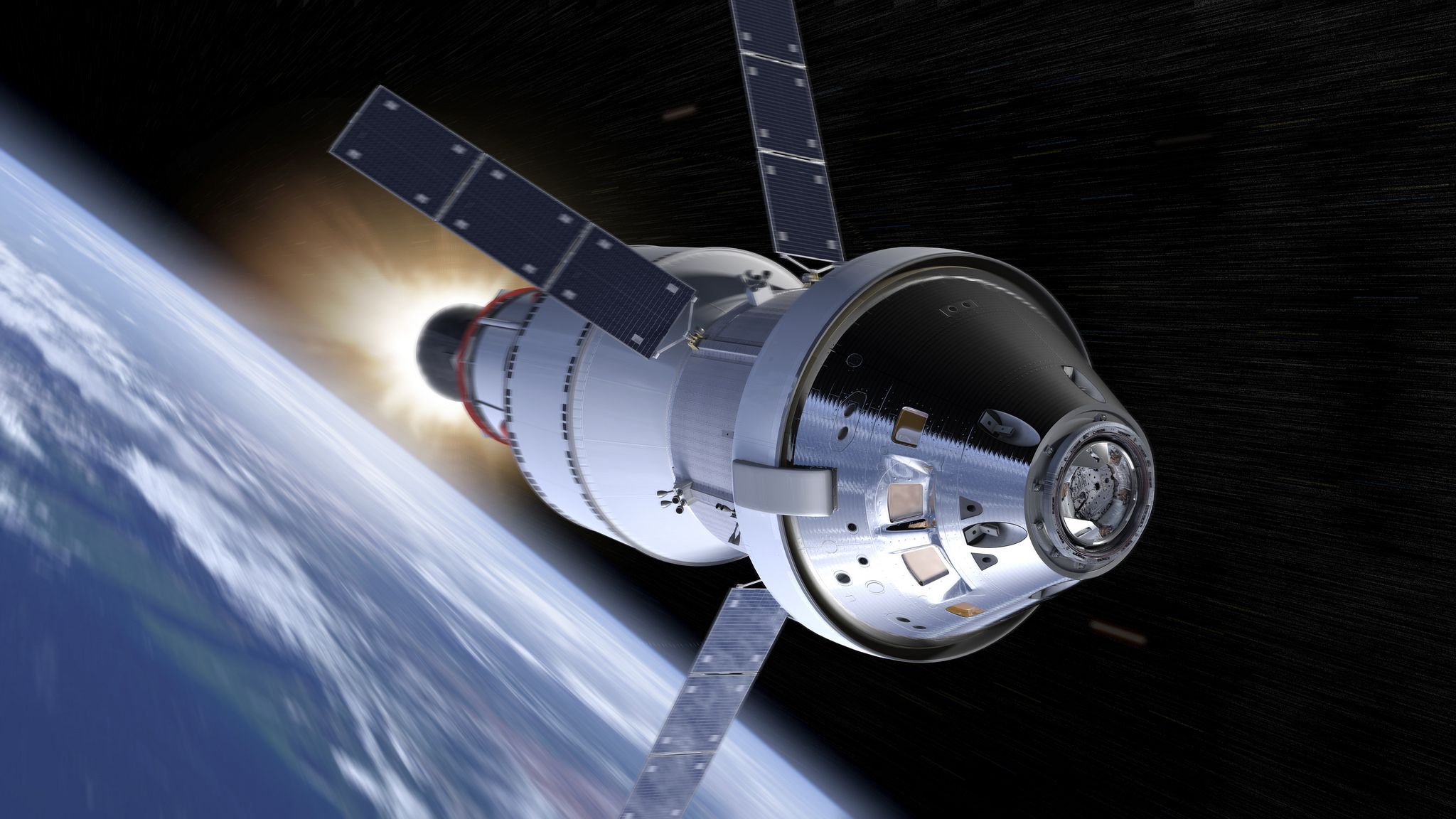
In February 2026, NASA plans to launch Artemis II, sending astronauts on a 10-day mission around the Moon. This mission will use the Space Launch System (SLS), one of the most powerful rockets ever built, to test technologies essential for future lunar landings. While the mission captures headlines, it also offers a real-world example of physics in action, showing how rockets turn scientific principles into the extraordinary feat of space travel.
At the heart of every rocket launch is Newton’s Third Law of Motion: for every action, there is an equal and opposite reaction. In the case of Artemis II, the SLS engines burn fuel and eject hot gases downward at tremendous speeds. The reaction to this downward thrust is the upward force that propels the rocket off the launch pad. Unlike cars or airplanes, rockets do not rely on air to push against; they work in the vacuum of space because the expelled gases provide the force needed to move in the opposite direction.
A rocket’s ability to leave Earth depends on generating enough thrust to overcome gravity. The SLS produces millions of pounds of thrust, more than enough to lift its massive structure and the astronauts it carries. Most of the fuel is burned in the first few minutes of launch because escaping Earth’s gravitational pull requires extreme energy. This initial phase, often called the “boost phase,” is critical: any inefficiency or delay could prevent the rocket from reaching orbit.
Fuel choice is also crucial. Artemis II uses a combination of liquid hydrogen and liquid oxygen, which, when burned together, release enormous energy. This energy is converted into kinetic energy, accelerating exhaust gases downward and generating the thrust that pushes the rocket skyward. This demonstrates the connection between chemistry and physics, showing that the principles of energy conversion are what power real space missions.
Another key feature of the SLS is staging. Rockets are built in sections, or stages, each with its own engines and fuel. As a stage runs out of fuel, it detaches, making the rocket lighter and more efficient. Staging ensures that the energy from each unit of fuel is used effectively, a principle rooted in momentum and mass calculations. By dropping mass that is no longer needed, the remaining stages can accelerate more easily, conserving fuel and increasing speed.
Once a rocket reaches space, different physics principles come into play. Orbiting the Moon or Earth requires balancing gravity and velocity. A spacecraft isn’t “floating” because there is no gravity; it’s constantly falling toward the celestial body, but its forward speed keeps it in orbit. Adjusting trajectory, velocity, and timing ensures that spacecraft like Artemis II reach their intended path around the Moon.
Modern rockets are also becoming reusable. While the SLS is a single-use rocket, other companies like SpaceX have developed rockets that can return to Earth, land safely, and be launched again. This innovation relies on precise calculations of acceleration, velocity, and reentry physics, reducing costs and making space travel more sustainable.
So why should high school students care about rockets like Artemis II? Beyond the excitement of space exploration, rockets illustrate fundamental physics concepts: Newton’s laws, energy conversion, mass and momentum, and orbital mechanics. They also show how multiple scientific disciplines, from chemistry to engineering, work together to achieve something extraordinary.
The Artemis II mission reminds us that rockets are more than machines; they are the practical application of physics that allows humans to explore the Moon, Mars, and beyond. Understanding how rockets work helps us appreciate both the science behind space travel and the human ingenuity that makes it possible.
Works Cited
Encyclopedia Britannica. “How Rockets Work: Newton’s Third Law of Motion Explained,” 2026. http://www.britannica.com/video/Newton-law-rocket-launch/-174176.
Glenn Research Center | NASA. “Propulsion System | Glenn Research Center | NASA,” November 20, 2023. http://www1.grc.nasa.gov/beginners-guide-to-aeronautics/propulsion-system/.
Sparrow, Giles, and All About Space magazine last updated. “How Rockets Work: A Complete Guide.” Space.com, June 30, 2021. http://www.space.com/how-rockets-work.