By Clélia Lassiouve, Year 11
The Cold War was a conflict between two ideologies of the two superpowers; the United States’ liberalism and the Soviet Union’s communism, that persisted from 1947 to 1991. The reference to the name “Cold War” comes from the principle that there was no direct conflict between these two superpowers, but rather many proxi-wars and global conflicts framed by the Cold War. This term “cold” is therefore meant to underline the absence of weapons and the heat that they are associated with. Tchequoslovakia, among other countries such as Hungary or Poland, was part of the “iron curtain” that separated the allies of the Soviet Union from the rest of Europe. These countries developed during the 20th century in a very different way than the rest of Europe, mainly because the URSS refused the Marshall Plan for its allied countries, which meant that the United States were not to fund the reconstruction of these countries and of their economies.
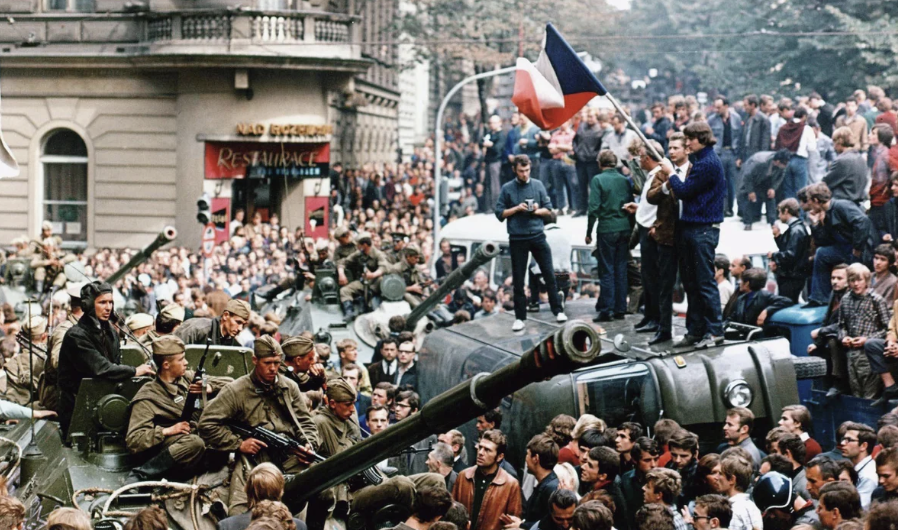
During these years of the Cold War Tchequoslovakia, once a country with intense ties with the Occidental democraties, became more and more isolated and absorbed into the larger commmunist block. In the late 60s, the elected Prime Minister Alexandre Dubček, surrounded by politicians who wished to reform the political system guided by an idea of “socialism with a human face”, advocated to implement democratic reforms. This movement called “Prague Spring” did not encounter an understanding or acceptance from the URSS and was brutally halted on the 21st of August of 1968 when the armies of the Warsow Pact entered the country and occupied its ground until November 1989.
Once under the occupationof the Soviet Union, the communist rule within the country was reinforced and omnipresent. All opposition was harshly punished, contacts with the world outside of the communist block were limited, people were not allowed to travel abroad to other than allied communist countries. The result of this was life without the right of free speech. Without the possibility to freely express and celebrate one’s religious beliefs. Those who opposed the regime were ousted from public life, lost their jobs and were often spyied upon by the local security services. Their families were also closely watched upon and often denied to pursue University studies and carreers. This was part of a large scale control mechanism intended to limit the increase of intellectual elite population and its access to public life. The economy switched into different modes characterised by controlled and planned economy models, lacking any global free trade relations. Official political propaganda governed the day to day life of society. This model seemed to work, but imploded under the weight of its absurdity.
Economically, the model was not sustainable, politically it kept supressing the elementary human rights, ideologically the regime had progressive emptied itself of sense. People started to realize this and eventually revolted in what became a larger regional mouvement of revolution, spread from Poland to Germany and to Chechoslovakia. The Velvet Revolution in 1989 represents the end of an era. The nation managed to end the regime and choose freedom, democracy and liberal economy over tyranny of the communist ideology.