By Eloise Fenton, Year 11
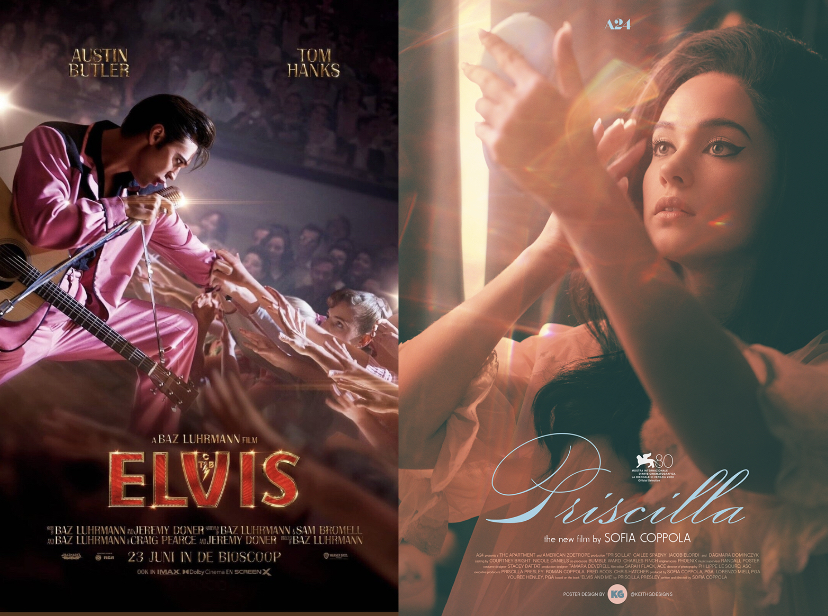
Ever since Elvis (released in 2022 and directed by Baz Luthrmann) and Priscilla (released in 2023 and directed by Sofia Coppola), the two films were destined to be compared by the public. The films present contrasting portrayals of the same historical pop culture icons. While Elvis is focused on creating the public myth of Elvis Presley as a one-of-a-kind legendary performer, Priscilla, on the other hand, reveals the vulnerable private reality of living as a woman next to the living myth. By using different perspectives, acting styles, blocking, dialogue, and film techniques, both directors shape the audience’s perception in distinct ways. However, when it comes to subtle storytelling, emotional intimacy, and impact, Priscilla comes across as the more effective film in exploring authentic perception. This is Elvis vs Priscilla: The Concept of Perception in Film.
In Elvis, Austin Butler plays the main role as Elvis Presley. His performance was bold and very theatrical, matching the film’s extravagant style. His vocal delivery, exaggerated movements and overall stage presence support the film’s idea of Elvis as this iconic, unreal performer rather than making a more emotional connection with him as a normal man, because at the end of the day, Elvis was human. The acting style strengthens the film’s focus on celebrity myth-making. These choices in acting make Austin Butler’s performance feel more like an Elvis impersonator rather than Elvis himself.
In contrast, Priscilla depends on naturalistic and subtle performances. The lead, Priscilla, is played by actress Cailee Spaeny. Her performance was quiet and vulnerable, using her facial expressions and subtle but natural body language to express Priscilla’s loneliness and emotional dependence on Elvis. In Priscilla, Elvis is played by Jacob Elordi. Jacob Elordi’s Elvis is much less extravagant, he’s calm, distant, and yet ready to snap at any moment, making him feel mysterious and always just out of reach. This portrayal of Elvis helps the audience understand Priscilla’s view of Elvis and her world, shaping the perception through realism.
In both films, blocking is used to reinforce power dynamics. In Elvis, Elvis is most always in the centre of the frame or high on stage with crowds around him. This represents how much attention was always on Elvis during his life. While in Priscilla it is the opposite, she is typically placed on the edge of the scene, visually representing to the audience how Priscilla is overshadowed by Elvis.
Sofia Coppola uses her blocking in Priscilla to express Priscilla’s imprisonment in Elvis’s life. This is done by having Priscilla alone sitting in large rooms, visually showing the audience her isolation. A motif used through blocking in Priscilla is her being framed behind windows and doorways to represent her captivity visually, caging her in Elvis’s life. Jacob Elordi’s Elvis normally occupied most of the space, framed directly in the middle, demonstrating how important he was in Priscilla’s life. Sofia Coppola uses the actor’s drastic height difference or having Elvis stand while Priscilla sits to represent his control over her and power imbalance. This type of blocking subtly guides the audience to realise Priscilla’s imprisonment without directly saying it.
Dialogue is also used to shape perception. In Elvis, dialogue is fast-paced, with excitement circling around fame, ambition, and music. Elvis reinforces the one-of-a-kind legendary performer perception by using the language to highlight his unreal type of performances and his destiny to be a star. A clear example of this is when discussing his career, Elvis states that performing is what he was “born to do.” Using the word “born” shows that not only is this talent something he worked hard for, but also something that is naturally gifted to him, demonstrating Elvis’s unreal legendary character in the film.
In Priscilla, dialogue is used much quieter and more emotionally revealing, explaining to the audience shifts in characters. Sofia Coppola also uses long pauses to reflect distance in the two’s relationship. This is made evident near the end of the movie when Elvis asked, “Am I losing you to another man?” The use of the word ‘I’ and ‘losing you’ shows Elvis assumes possession over Priscilla. While her response, “No, you’re losing me to my own life,” demonstrates her independence (unlike Elvis’s sentence), this sentence is a phrase around her and her own wants. This is a huge change from earlier scenes in the film, when her dialogue was much more surrounded around Elvis and complying with his wants. This shift from the beginning to the end helps the audience perceive Priscilla’s emotional growth.
The biggest difference between Elvis and Priscilla is how each film presents private life versus the public image, both styles of the films strengthen this perception for the audience. This is demonstrated in Elvis, Baz Luhrmann celebrates the making, piece by piece, of the cultural legend. He adds concerts with fans circling Elvis trying to touch the myth, always just out of reach of grabbing him, and flashing lights with fast-cut edits and sweeping in-camera movements to try to immerse the audience in his fame, though just like the audiences in the movie, we the audience are always just out of reach from fully being able to understand, connect, and know who Elvis really is. Elvis is framed as a powerful figure, through the fast-paced storyline, edits, bright colours, loud music and overall sensory overload, we see the excitement of Elvis’s life and celebrity culture, leaving the viewer to admire the myth of a performer. Though this type of style left me overstimulated and honestly made me feel disconnected from the film as a whole, I wish there were more slow scenes, scenes where the audience can sit and feel Elvis’s emotional impact from all the fame. I believe it would leave the audience with a better understanding of who Elvis really was. Overall, this energetic style uses perspective to illustrate Elvis’s public persona, making his fame feel glamorous.
In contrast, Priscilla reveals the emotional cost of the fame through its style. Sofia Coppola uses soft lighting, muted colours, static framing, and silence to show the intimacy Priscilla had with Elvis, how dull her life can be with Elvis, and her crippling isolation. Even though the movie is centred around Priscilla and her relationship with Elvis, scenes of her alone, waiting for Elvis, tell us more about the relationship, the audience can understand her longing for him, wanting to be perfect and loved by him. In this film the character Elvis is presented not as a legend but instead as a distant husband whose fame causes him to be pushed away from Priscilla. Yet Sofia Coppola makes the viewer feel sympathy for Elvis, the audience can understand the struggle of Elvis, the lack of freedom, the lack of control, the lack of days not constantly being exploited by others, and the stress. This is all done by slow pacing, long shots that focus on characters’ faces, and minimalist style shifts. This is a noticeable difference from the film Elvis, though this style in Priscilla can make the audience focus on how restrictive and lonely both Elvis’s and Priscilla’s lives must have been.
Though Elvis is visually entertaining, Priscilla uses the concept of perception more effectively in exploring its characters and theme. Elvis is too focused on his iconic performances and public persona, which makes the film tend to sideline his emotional depth, making it hard to connect with Elvis overall. On the other hand, Priscilla uses subtle acting, quiet dialogue, controlled blocking, and intimate film style to craft a deeply personal story that makes the audience think about the life around Elvis, who is forced to be overshadowed and obey. Rather than presenting another character’s perspective, Priscilla demonstrates how perspective can shape our reality, making the audience feel more like Priscilla while watching the film, challenging the viewer to think about the film after watching it. This is how Priscilla uses the concept of perception to show emotional truth and use it as the centre of the film.
To conclude, Elvis and Priscilla perfectly illustrates how perception is used to define a story. By presenting the same pop cultural figures through opposing lenses, each film constructs a different truth. Elvis is more focused on creating an idea of the public myth and legend, and Priscilla uncovers a deep emotional reality of both facing being a star and living next to that star. Through Priscilla’s character-driven focus plot, Priscilla is not only a better film but also uses the concept of perception more effectively to connect to the audience.