By Wu Zhang, Year 12
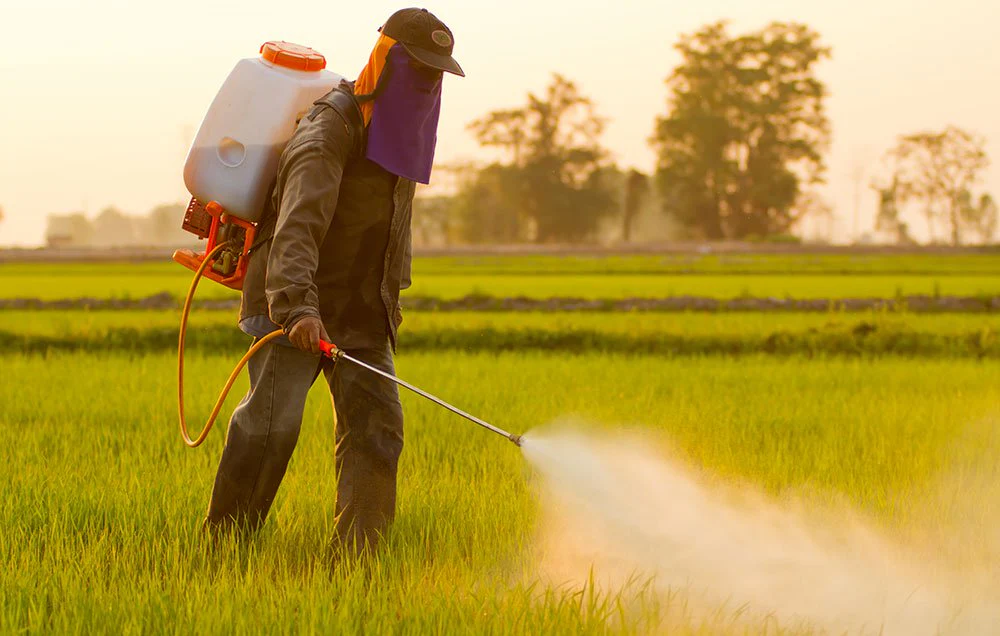
As the global population grows, agriculture faces a challenge to produce more food with limited resources. Pesticides are chemicals that play a key role in controlling insects, weeds, and fungi, but their effectiveness and risks depend on their chemistry. They can be classified into specific categories depending on their target organisms.
Insecticides often target the nervous system of insects. A major class of organophosphates (phosphate esters), which inhibit enzymes like acetylcholinesterase from breaking down neurotransmitters like acetylcholine, causing them to accumulate and continuous nerve stimulation that can lead to paralysis and death.
Herbicides are used to eliminate unwanted plants and weeds. An example is glyphosate, a molecule that inhibits enzymes involved in amino acid synthesis in plants like EPSP synthase (5-enolpyruvylshikimate-3-phosphate. This biochemical pathway, which is absent in humans, makes glyphosate relatively selective and safe to use on crops. Herbicides demonstrate how biochemical differences between organisms can be exploited through chemical design, allowing for targeted toxicity.
Fungicides are another type of herbicide that disrupts key biological processes in fungi, such as membrane integrity and enzyme activity. Many contain heterocyclic compounds (cyclic compounds with elements other than carbon) that interfere with sterol synthesis, which is essential for fungal cells.
At the molecular level, pesticide function is determined by their structure, like all other chemicals. Functional groups influence the type and reactivity of interactions, polarity of molecules determines the solubility and transport of pesticides, and stability determines how long the pesticide can last. For example, DDT (dichlorodiphenyltrichloroethane)- despite its long name- contains multiple chlorine atoms attached to aromatic rings that make it highly nonpolar and chemically stable. This nonpolarity allows it to dissolve in lipids rather than water. Furthermore, the chlorine to carbon bonds are extremely strong and resistant to degradation, allowing it to stay in the environment for a long time. This stability may be good for long-term pest control, but it also contributes to environmental harm.
The accumulation of these pesticides over time is known as bioaccumulation, where it can lead to biomagnification when substances move up the food chain, and their concentration increases proportionally. e.g., Water • Plankton • Fish • Birds • Humans.
This is most apparent with pesticides that contain halogen atoms (like chlorine) that are extremely stable and accumulative.
Recent advances aim to design pesticides that are both effective and environmentally sustainable. For example, biodegradable pesticides are engineered to break down more rapidly; neonicotinoids target insect nervous systems more selectively but are still controversial for their effects on bees; biopesticides that are derived from natural substances offer reduced toxicity and environmental persistence.
In conclusion, pesticides are powerful chemical tools that have helped maintain agriculture and contributed to global food security. However, their behaviours and chemical properties can lead to negative environmental interactions and raise safety concerns in humans due to bioaccumulation.
Works Cited
education.nationalgeographic.org. “Biomagnification,” n.d. https://education.nationalgeographic.org/resource/biomagnification/.
National Pesticide Information Centre. “Glyphosate General Fact Sheet.” Orst.edu, 2019. https://npic.orst.edu/factsheets/glyphogen.html.
US EPA. “Pesticides | US EPA.” US EPA, April 2019. https://www.epa.gov/pesticides.
Wikipedia Contributors. “EPSP Synthase.” Wikipedia. Wikimedia Foundation, July 13, 2019. https://en.wikipedia.org/wiki/EPSP_synthase.