By Sarah Hines, Year 11
The term « STEM » was invented very recently, but it took many centuries of evolution and this to happen.
Engineering and science have been around since the beginning of time. Still, they were first integrated into the school system during the 17th century, thanks to the Morrill Act of 1862, which made it possible for states to establish colleges that included subjects such as agriculture and mechanical arts. But during this period, these subjects were mainly used for farming and nothing more.
These practices continued to be taught throughout the 19th century and encouraged people to start creating jobs in these areas. This triggered things like the discovery of radium and electricity, making many people gain interest in these domains and encouraging them to focus their careers in the latter. These discoveries resulted in the creation of many new inventions, such as cars, radios, televisions…things that are still being innovated today. This naturally progressed into many advances and improvements in war machines and weapons. World War II was a wake-up call for many since it was the first time an atomic
bomb was used. This shocked a lot of people as they had not realised the true speed at which inventions were being produced. In fact, this war helped countries develop even more weapons than before, as they could use and improve other people’s creations and compare their advances.
Even after the war, this continued and progressed into the space race. The USSR and the United States confronted each other through the latter, determined to beat each other in this domain, achieving more and more impressive feats. This eventually resulted in the first man landing on the moon in 1969, achieved by the Americans. This period encouraged more students than before to study science and engineering since the country needed them to be able to beat the opposing power. After this came a rush of even more life-changing inventions, such as the World Wide Web (invented in CERN) and cell phones, but also lots of scientific creations, such as artificial organs and advancements in surgery, particularly transplant surgeries, followed by outpatient surgeries.
During the 1990s, the term “SMET” was invented by the National Science Foundation (NSF), meaning “Science, Mathematics, Engineering and Technology”. This was used to define all analytical thinking and science competencies. This helped students direct themselves more clearly towards the right career path as all of the latter were linked under one big subject. Not long after, the term got changed to “STEM” by Judith Ramaley, the Director of Education and Human Resources at the NSF.
In the following years, STEM education became an official term, and things like degrees and Grants greatly helped the growth of the latter. It was only a matter of time before the results started pouring in and countries began to compare their academic achievements in schools and universities. This encouraged many countries to start promoting this education like never before, not wanting to fall behind on the universal scale. For instance, America established the “Educate to Innovate Initiative” in 2019. This involved preparing over 100,000 STEM teachers and increasing federal funding like never before toward STEM education to move American students to the top in science and math achievements.
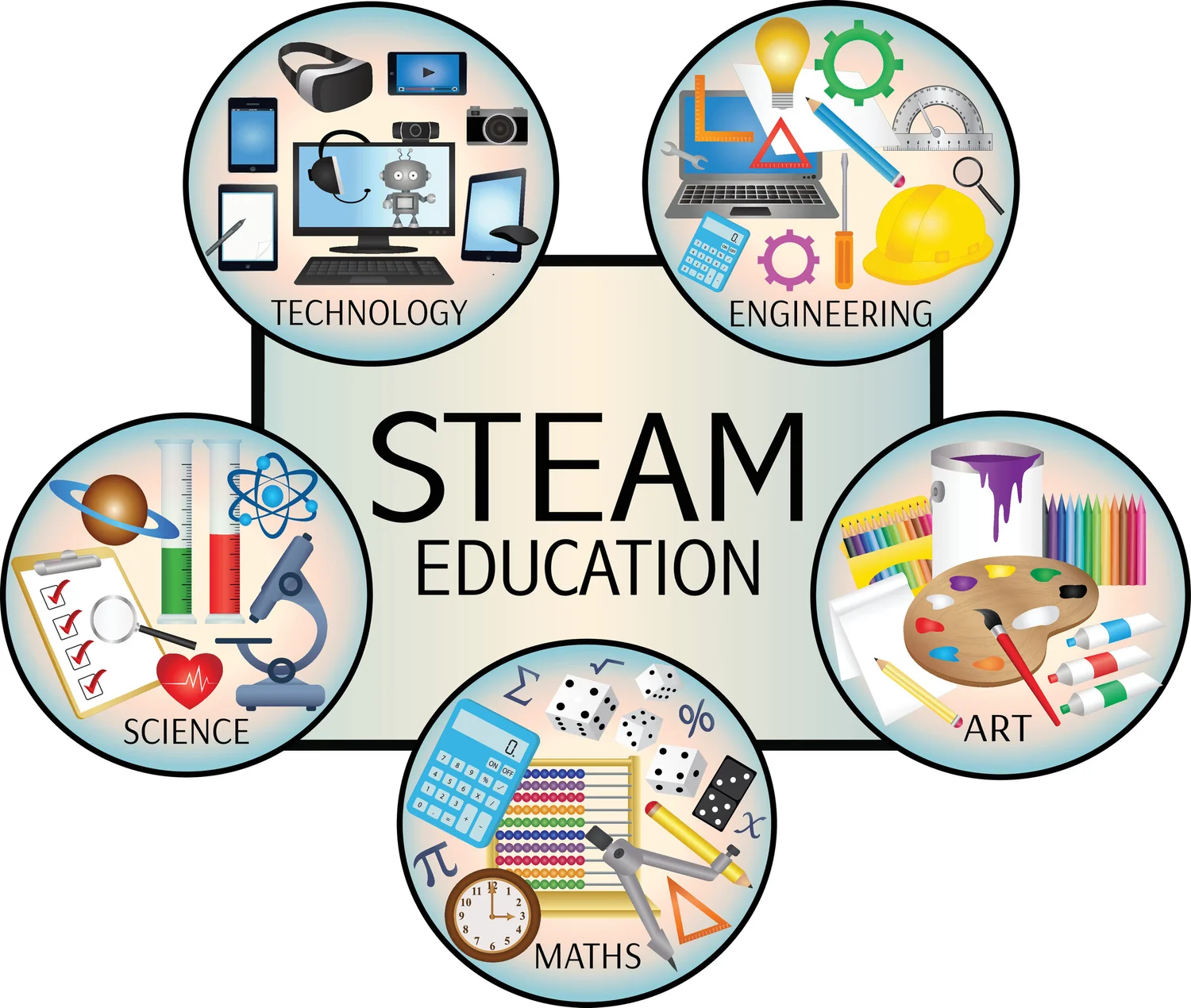
Very recently, many programmers and engineers started talking about including the arts in the official STEM acronym, converting it to “STEAM”. This has already been achieved in many institutions, such as the International School of Switzerland, Lancaster Mennonite High School, which views the arts as an important base of STEM, giving it the right to be in the title.
Over the years, the concept of STEM has dynamically evolved, and even today, there are still many aspects of it that are yet to be explored and modified. For instance, there is a big campaign promoting women in STEM, as this has been a career path mainly reserved for men up till now. Also, the integration of many subjects (such as computer science) and many jobs into this category of STEM demonstrates how fast it is expanding and its importance in today’s society, filled with advancements in technology and science.
Works Cited
“Morrill Act (1862).” National Archives, 10 May 2022, www.archives.gov/
milestone-documents/morrill-act. Accessed 17 Nov. 2025.
“Rich History of STEM Education in the United States.” STEM School,
www.stemschool.com/articles/rich-history-of-stem-education-in-the-united-states.
Accessed 17 Nov. 2025.
“Why STEAM?” Wa4steam, 2025, wa4steam.com/about-us/what-is-steam/. Accessed 17
Nov. 2025.