By Skyler Mason, Year 12
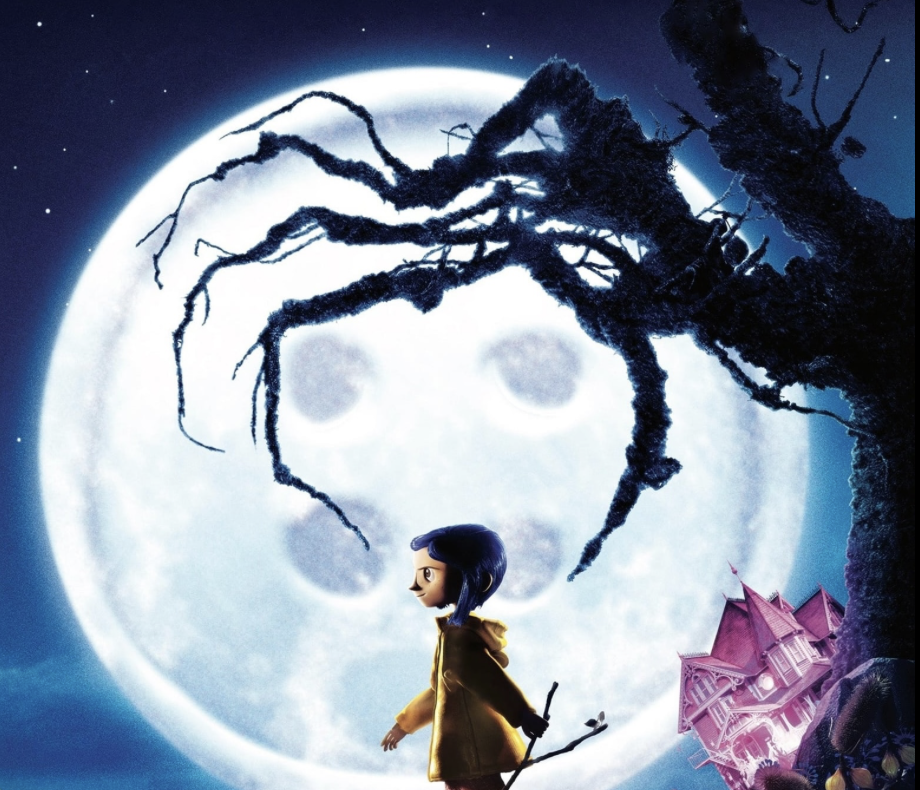
With winter break right around the corner, there’s no better time to curl up and rewatch your favourite films, and if you’re looking for a recommendation, I heavily suggest Coraline.
Filmed and produced in 4 years using over 130 meticulously crafted sets and puppets, Coraline was a major success, grossing over $124 million internationally solely through its initial release.
However, despite being considered one of the best stop-motion films of all time, it’s unfortunate how often it’s written off as “just a children’s movie”. So, in order to fully appreciate its layers, I’ll discuss the incorporation of horror elements and specific details, and how these reflect the true excellence of Coraline.
Horror
One of the reasons Coraline is often overlooked and underappreciated is that it can get trapped in the expectation of being for children. While I don’t argue that Coraline has considerable visual appeal to younger audiences with its colourful, imaginative, and often fantastical elements, many critics recommend parental guidance due to its dark themes and often unsettling imagery.
This is supported by the fact that the film makes several references to other well known horror movies. For example, the chair featured in Coraline’s room has the same make and design as the chair Jack Torrance uses in The Shining. Additionally, in a scene where Coraline’s father is playing with her squid plushie, he jokingly puts it over his face in reference to the movie Alien. Moreover, the movie contains various aspects of horror cinematography such as using dutch angles (a type tilted angle), claustrophobia in the tunnel, and exploring the unnerving themes of child abduction and character disfigurement. These elements collectively build an unsettling atmosphere which contributes heavily to the overall ambiance of the film.
Details
Furthermore, another way in which Coraline surpasses expectations is through the impressive level of continuity held in motifs and themes.
This can be seen in the consistent mirroring of insects in both the real and other world. For example, in the real world Coraline wears a dragonfly pin in her hair while in the other world, she has toy dragonflies which fly around her bedroom. In addition to this, her mantis picture frame holder is mirrored through the tractor the other father rides in the magical garden. Another figure which repeats throughout the film is the importance and characterization of the other mother’s hand. It appears as the symbol of “grave danger” in Coraline’s tea leaves and also appears in the form of a lightning strike, showing both foreshadowing and pathetic fallacy with hidden messaging.
This unique attention to detail is also evident in less conspicuous parts of the film. For instance, while Mr. Bobinsky’s blue complexion does not stand out excessively given the fantastical elements of the film, there actually is an explanation given. To accompany his accent, he wears a unique medal that was only awarded to the liquidators who helped clean up the Chernobyl nuclear disaster, which would imply his blue colouring is a result of radiation exposure. Another example which illustrates this is the double loop in the writing “Welcome Home”, which is featured on the cake given to Coraline. According to graphology, the study of handwriting, this indicates deception and is heavily linked to pathological liars.
The abundance of hidden meanings is one of my favourite parts of the movie: every rewatch rewards the viewer with more details to be noticed. Even if some connections seem far too obscure to be intentional, in a stop motion with 24 frames per second, every detail is purposeful. This level of intentionality makes Coraline the gift that keeps on giving.