By Wu Zhang, Year 12
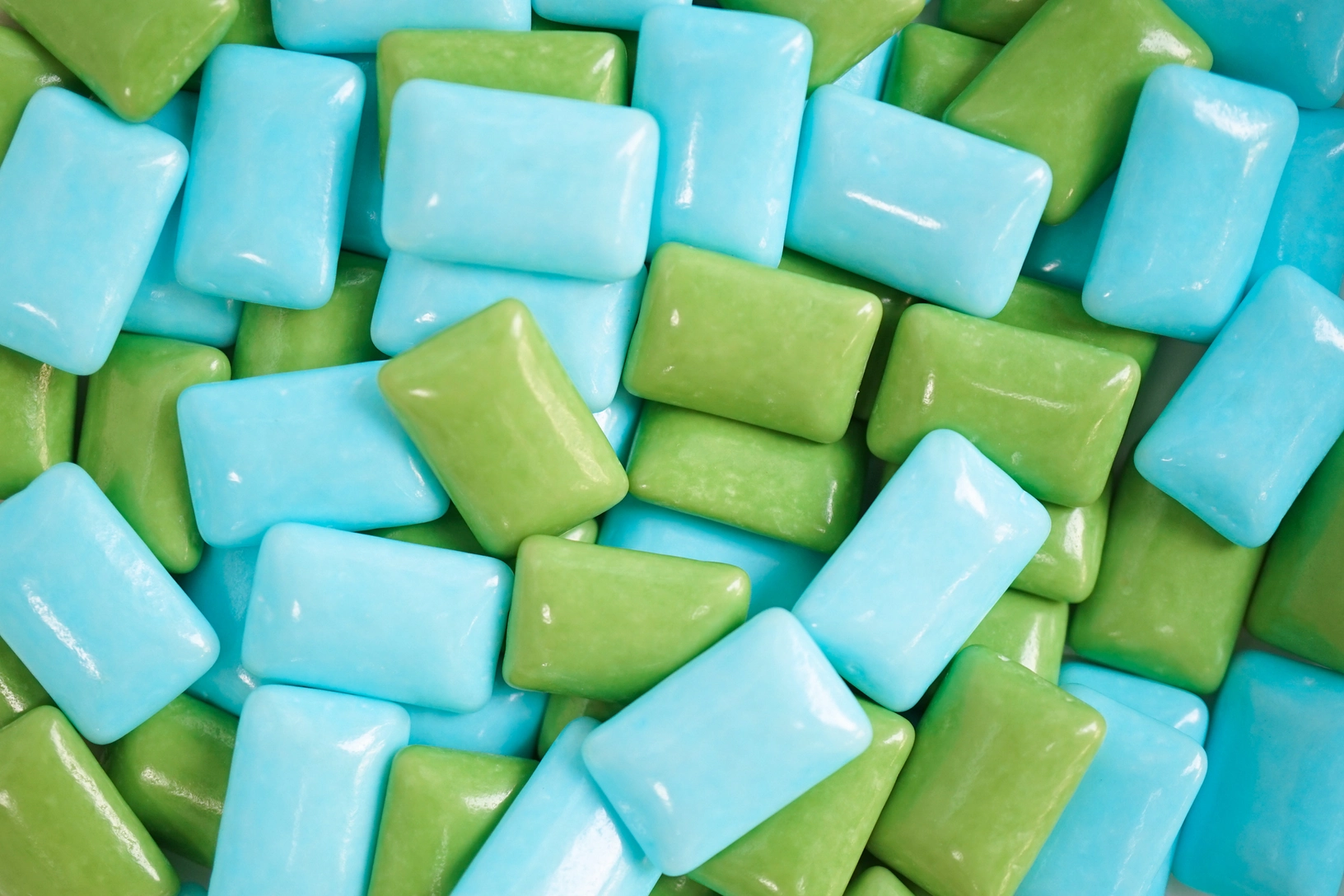
Gum is regarded as a fascinating and satisfying material that combines properties of both solids and liquids (and can be considered a non-Newtonian fluid). Its unique elasticity, flexibility, and ability to retain flavour for long periods are all explained by its chemical composition and molecular structure. At its core, chewing gum is a mixture of polymers, sweeteners, softeners, and flavouring agents, all designed to create a substance that is stable, elastic, and enjoyable to the mouth.
The most important component of chewing gum is figuring out the gum base, which determines the gum’s elasticity and chewy properties. The gum base consists mainly of polymers, which are long chains of repeating molecular units. Some common synthetic polymers used to increase elasticity (elastomers) include:
- Polyvinyl acetate, which helps gum be sticky, flexible and soft- (−CH2−CH(OCOCH3)−)n
- Polyethylene, which helps gum be strong, flexible and waterproof (due to the non-polar ethenes)- (−CH2−CH2−)n
- Butadiene-styrene rubber, which consists of butadiene (flexible properties) and styrene (strong properties).
These polymers are actually similar to those used in plastics and rubber. Their long chains can bend, stretch, and slide past each other without breaking, which gives gum its flexibility. This behaviour is explained by intermolecular forces, particularly London dispersion forces due to the large molar masses of polymers and nonpolarity of the molecules, which hold the chains together while still allowing movement.
Because of this structure, gum is described as a viscoelastic material, meaning it shows both elastic behaviour (it can undergo stretching and return to its original shape) and viscous (it flows slowly under stress). This is why gum can stretch into a bubble but also slowly deform over time.
The gum base also contains additional components that influence its physical properties. Fillers such as calcium carbonate or magnesium silicate (talc) are added to increase volume and improve texture. Talc is especially useful when acidic flavourings are present because calcium carbonate would react with acids to release carbon dioxide gas, which will cause decomposition and textural differences.
For flavour, sweeteners such as sugar, xylitol, or artificial sweeteners are added to provide flavour. These substances are water-soluble and dissolve in saliva during chewing to help taste efficiency. As they dissolve and diffuse out of the gum, the sweetness will gradually decrease proportionally. In contrast, the polymer base is insoluble in water, which prevents the gum from dissolving quickly and allows it to be chewed for extended periods.
In conclusion, the chemistry of chewing gum is based on polymer science, intermolecular forces, and flavouring agents. Synthetic polymers provide elasticity and durability, fillers and softeners control texture, and sweeteners and flavour molecules provide taste. These components interact at the molecular level to produce the unique properties of chewing gum. This demonstrates how polymer chemistry plays an important role in determining the physical properties of everyday materials.
Works Cited
www.acs.org. “The Secret Science of Gum – American Chemical Society,” 2025. https://www.acs.org/education/whatischemistry/adventures-in-chemistry/secret-science-stuff/gum.html.
www.sciencefocus.com. “What Is in Chewing Gum?,” n.d. https://www.sciencefocus.com/science/what-is-in-chewing-gum.