By Clélia Lassiouve, Year 11
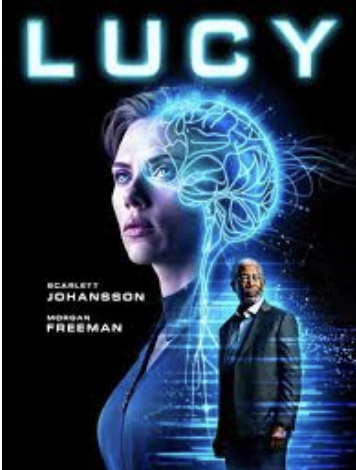
In the science-fiction film Lucy, directed by Luc Besson the protagonist suddenly gains access to the full capacity of her brain after getting drugged by an unknown drug. As her cognitive abilities expand, she begins to perceive time differently, access memories with perfect clarity, and ultimately understand the world at a level far beyond ordinary human experience. The film’s central idea—that a human could unlock limitless knowledge and sensation by using 100% of their brain—has fascinated audiences for years. While scientifically exaggerated, it raises an interesting question for today’s world: in an age where artificial intelligence is rapidly advancing and offering instant access to vast amounts of information, are we moving closer to something like Lucy’s abilities? And could we ever overcome them?
Artificial intelligence today already gives us the illusion of enhanced human understanding. With a few words typed into a search engine or an AI system, we can access centuries of scientific research, philosophical ideas, artistic works, and cultural knowledge from across the globe. In a way, AI functions as an external extension of our minds. It gives us access to all the understandings of humanity of all time.
The comparison to Lucy becomes particularly interesting when we consider how AI allows us to “feel” or understand experiences beyond our own. Through AI-curated content, simulations, and digital storytelling, we can learn about lives and cultures we have never personally encountered. We can explore the depths of space, the intricacies of the human brain, or the history of civilizations with unprecedented ease. It can feel as though technology is bringing us closer to a state where knowledge is not limited by time, geography, or individual experience. However, there is a crucial difference between the abilities portrayed in Lucy and what AI actually offers. In the film, Lucy’s expanded brain capacity allows her not only to know facts but to experience reality more deeply—to sense emotions, time, and human connection in an entirely new way. She feels the division of cells within her body, stimuli flooding through her neurons. AI, by contrast, processes information but does not feel it. It can describe love, grief, joy, and fear, but it does not experience them. It can generate an explanation of a human life, but it does not live one.
This distinction highlights something essential about human intelligence. Our understanding of the world is not only based on information but also on consciousness, emotion, memory, senses and subjective experience. I would argue these experiences are even more relevant than knowldegdge. When a person listens to music, their interpretation is shaped by their own life, their relationships, and their feelings. Even if AI can provide access to all the knowledge ever recorded, it cannot replicate the personal meaning that knowledge takes on within a human mind.
Moreover, the idea that humans only use 10% of their brain is itself a myth. Neuroscience shows that we already use virtually all parts of our brain, though not all at the same time. The concept of “unlocking 100%” is less about unused brain tissue and more about imagining the full potential of human cognition—creativity, empathy, critical thinking, and self-awareness combined. These qualities are not just about processing power; they are about being human.
As AI continues to develop, it will undoubtedly become an even more powerful tool for learning and understanding. It may help us solve complex global problems, improve education, and expand access to knowledge for millions of people. In that sense, AI can help humanity move closer to a more informed and connected world. It can amplify our intelligence and support our curiosity. Yet, even in a future where AI becomes incredibly advanced, it is unlikely to replicate or surpass the full depth of the human mind. The brain is not just a machine for storing and processing data; it is the source of consciousness, imagination, moral judgment, and emotional experience. It is shaped by biology, environment, and personal history in ways that cannot be reduced to algorithms.
The story of Lucy ultimately reminds us of the extraordinary potential of the human mind—not because we can literally reach 100% and gain supernatural powers, but because our capacity for thought, feeling, and understanding is already uniquely complex. It is not just about how much we can know, but about how deeply we can feel and understand what it means to be human.